
Almost all of the company’s major models, including the Elantra, Optima, and Sonata, have the 2.0-liter Hyundai G4NA engine, which was first introduced by the company in 2010. Under its L4NA index, this engine is available in a gas version without gasoline injectors.
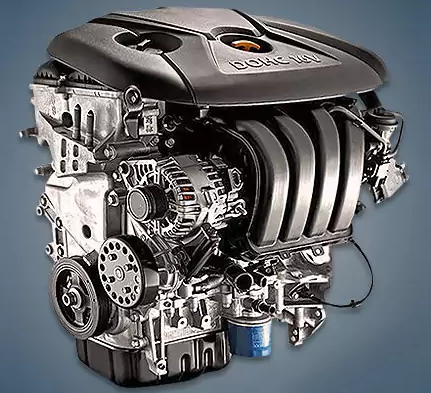
A 2.0-liter engine was first introduced by Hyundai-Kia in 2010 as part of the new Nu line. With distributed fuel injection, an aluminum block with thin-walled cast-iron liners, an open cooling jacket, a 16-valve head with hydraulic compensators, a timing chain, phase shifters on two shafts, and a plastic intake manifold with a VIS geometry change system, this power unit was fairly standard for the time.
The power unit was continuously improved by the Korean company’s engineers, and the most beneficial development was the introduction of oil piston cooling nozzles in 2017. Naturally, the issue with seizures in the cylinders did not go away after that, but it did become less frequent.
The engines in the Nu family are G4NB, G4NA, G4NC, G4ND, G4NE, G4NH, G4NG, G4NL, and G4NN.
The engine was mounted on:
- Hyundai Creta 1 (GS) since 2015;
- Hyundai Creta 2 (SU2) since 2021;
- Hyundai Elantra 5 (MD) in 2013 – 2016; Elantra 6 (AD) since 2015;
- Hyundai ix35 1 (LM) in 2013 – 2015;
- Hyundai i40 1 (VF) in 2011 – 2019;
- Hyundai Sonata 7 (LF) in 2014 – 2019; Sonata 8 (DN8) since 2019;
- Hyundai Tucson 3 (TL) since 2015;
- Kia Carens 4 (RP) in 2015 – 2018;
- Kia Cerato 3 (YD) in 2012 – 2018; Cerato 4 (BD) since 2018;
- Kia K5 3 (DL3) since 2019;
- Kia Optima 3 (TF) in 2013 – 2016; Optima 4 (JF) in 2015 – 2020;
- Kia Soul 1 (AM) in 2011 – 2014; Soul 2 (PS) in 2013 – 2019; Soul 3 (SK3) since 2019;
- Kia Sportage 3 (SL) in 2014 – 2016; Sportage 4 (QL) since 2015.
Specifications
| Production years | since 2010 |
| Displacement, cc | 1999 |
| Fuel system | distributed injection |
| Power output, hp | 150 – 167 |
| Torque output, Nm | 190 – 200 |
| Cylinder block | aluminum R4 |
| Block head | aluminum 16v |
| Cylinder bore, mm | 81 |
| Piston stroke, mm | 97 |
| Compression ratio | 10.3 |
| Features | VIS |
| Hydraulic lifters | yes |
| Timing drive | chain |
| Phase regulator | yes |
| Turbocharging | no |
| Recommended engine oil | 5W-20, 5W-30 |
| Engine oil capacity, liter | 4.5 (there are versions of the engine with an oil pan volume of 6.5 liters) |
| Fuel type | petrol |
| Euro standards | EURO 4/5 |
| Fuel consumption, L/100 km (for Hyundai Tucson 2018) — city — highway — combined |
10.9 6.6 8.2 |
| Engine lifespan, km | ~300 000 |
| Weight, kg | 117 |
Disadvantages of the Hyundai G4NA engine
The appearance of scoring in the cylinders is this unit’s biggest issue. The weak catalyst is the cause; our fuel quickly destroys it, and when it clogs, its crumbs are drawn into the combustion chambers and cause scratches on the walls.
Scuffs in the cylinders may not be the only cause of lubricant consumption in such a unit. They have an open cooling jacket and relatively thin cast-iron sleeves by design, and they can easily become elliptical with frequent overheating or active use.
The timing chain can run 300,000 kilometers for calm drivers, but if you run the engine nonstop, its capacity will be reduced by at least half; there are numerous examples of replacements up to 100,000 kilometers. Instead of breaking when stretched, the chain typically jumps and frequently bends the valves.
They complain on specialized forums about frequent lubricant and antifreeze leaks caused by weak gaskets, a relatively small resource of the power unit supports, generator clutch, and water pump. Additionally, the motors from the early years had weak liners that could be easily turned.