
Since its 2011 debut on the Hyundai i40 2.0 GDi, the 2.0-liter Hyundai G4NC engine has gained widespread acceptance in both the European and American automotive markets. The use of a unique direct fuel injection system sets this power unit apart.
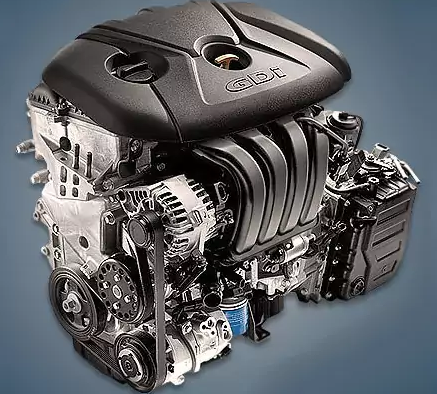
A 2.0-liter GDi direct injection engine made its debut as a member of the Nu family in 2011. Apart from the direct fuel injection system, it is identical to other units in the line: a timing chain drive, a plastic intake manifold with a geometry change system VIS, an aluminum 16-valve head with hydraulic compensators, phase shifters on both shafts, and an aluminum block with cast-iron liners and an open cooling jacket.
Like other engines in the series, this engine underwent multiple improvements during production. First, separators were added to the cooling jacket, followed by oil nozzles in the block.
The engines in the Nu family are G4NB, G4NA, G4NC, G4ND, G4NE, G4NH, G4NG, G4NL, and G4NN.
The engine was mounted on:
- Hyundai i30 2 (GD) in 2013 – 2016;
- Hyundai i40 1 (VF) in 2011 – 2018;
- Hyundai ix35 1 (LM) in 2013 – 2015;
- Hyundai Tucson 3 (TL) in 2015 – 2020;
- Kia Carens 4 (RP) in 2013 – 2018;
- Kia Cerato 3 (YD) in 2012 – 2018;
- Kia Sportage 3 (SL) in 2014 – 2015; Sportage 4 (QL) in 2015 – 2020.
Specifications
| Production years | since 2011 |
| Displacement, cc | 1999 |
| Fuel system | direct injection |
| Power output, hp | 150 – 177 |
| Torque output, Nm | 192 – 213 |
| Cylinder block | aluminum R4 |
| Block head | aluminum 16v |
| Cylinder bore, mm | 81 |
| Piston stroke, mm | 97 |
| Compression ratio | 11.5 |
| Features | VIS |
| Hydraulic lifters | yes |
| Timing drive | chain |
| Phase regulator | yes |
| Turbocharging | no |
| Recommended engine oil | 5W-20, 5W-30 |
| Engine oil capacity, liter | 4.6 (there is a version with a 5.8 liter pallet) |
| Fuel type | petrol |
| Euro standards | EURO 5/6 |
| Fuel consumption, L/100 km (for Hyundai i40 2014) — city — highway — combined |
10.6 6.1 7.8 |
| Engine lifespan, km | ~300 000 |
| Weight, kg | 120 |
Disadvantages of the Hyundai G4NC engine
It raises them by sucking catalyst crumbs into the cylinders and inflating thin cast-iron liners, just like its counterparts in the series with distributed injection.
The timing chain can cover several hundred thousand kilometers for inactive drivers, but it can only cover 100–150 thousand kilometers when driving aggressively and with abrupt starts. Instead of breaking when stretched, the chain jumps and nearly always bends the valves.
As is the case with all engines that use direct fuel injection, the intake valves have a serious soot problem that prevents them from closing tightly. All of this causes the motor to operate unsteadily, necessitating decoking.
Additionally, they frequently complain about oil leaks on specialized forums because of weak gaskets, low water pump, generator, and other attachment resources, and units from the early years of production that had weak liners and occasionally turned them.