
With the third and fourth generation Optima, Hyundai’s 2.0-liter G4ND engine, which was added to the Nu powertrain family in 2011, gained popularity. The CVVL valve lift system is the motor’s standout feature.
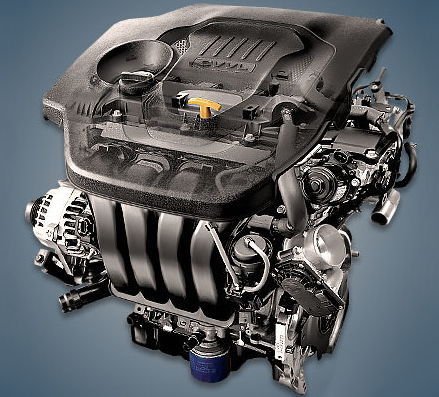
A 2.0-liter engine with a CVVL system that continuously modifies valve stroke based on engine speed was added to the Nu lineup in 2011. A timing chain, a phase control system on two shafts, an intake manifold with variable geometry VIS, an aluminum block and cast-iron liners, an aluminum 16-valve cylinder head with hydraulic lifters, and distributed fuel injection are all features of this traditional engine.
Small plastic separators were added to the engine cooling jacket in 2014 to slightly increase the movement of antifreeze in the top and most stressed part of the cylinders. The long-awaited piston cooling oil jets were finally added in 2017, and scuffing issues have significantly decreased, if not completely disappeared.
The engines in the Nu family are G4NB, G4NA, G4NC, G4ND, G4NE, G4NH, G4NG, G4NL, and G4NN.
The engine was mounted on:
- Hyundai Elantra 5 (MD) in 2013 – 2015;
- Hyundai i40 1 (VF) in 2011 – 2019;
- Hyundai ix35 1 (LM) in 2013 – 2015;
- Hyundai Sonata 6 (YF) in 2012 – 2014; Sonata 7 (LF) in 2014 – 2019;
- Hyundai Tucson 3 (TL) in 2015 – 2020;
- Kia Carens 4 (RP) in 2013 – 2018;
- Kia Cerato 3 (YD) in 2012 – 2018;
- Kia Optima 3 (TF) in 2012 – 2016; Optima 4 (JF) in 2015 – 2020;
- Kia Sportage 3 (SL) in 2013 – 2016; Sportage 4 (QL) in 2015 – 2020;
- Kia Soul 2 (PS) in 2013 – 2019.
Specifications
| Production years | since 2011 |
| Displacement, cc | 1999 |
| Fuel system | distributed injection |
| Power output, hp | 150 – 172 |
| Torque output, Nm | 195 – 205 |
| Cylinder block | aluminum R4 |
| Block head | aluminum 16v |
| Cylinder bore, mm | 81 |
| Piston stroke, mm | 97 |
| Compression ratio | 10.3 |
| Features | VIS |
| Hydraulic lifters | yes |
| Timing drive | chain |
| Phase regulator | yes |
| Turbocharging | no |
| Recommended engine oil | 5W-20, 5W-30 |
| Engine oil capacity, liter | 4.8 |
| Fuel type | petrol |
| Euro standards | EURO 5/6 |
| Fuel consumption, L/100 km (for Kia Optima 2014) — city — highway — combined |
10.3 6.1 7.6 |
| Engine lifespan, km | ~300 000 |
| Weight, kg | 124 |
Disadvantages of the Hyundai G4ND engine
The appearance of scuffing in the cylinders, which results from catalyst crumbs entering the combustion chamber directly, is the primary source of complaints from the owners of these engines. When piston oil cooling nozzles were introduced in 2017, the issue was resolved.
Not only does scoring cause oil consumption, but piston rings—which are extremely narrow and quickly coke—also cause it. However, the engine’s design is usually the cause: thin cast-iron liners can easily become elliptical when the cooling jacket is open.
The timing chain has a respectable resource and can easily travel 200–300 thousand kilometers without needing to be replaced when the machine is not operating very actively and does not experience frequent slipping or abrupt acceleration. However, it frequently reaches 150,000 kilometers for overheated owners.
Although the CVVL valve lift system is not inherently unreliable, it is frequently damaged by aluminum chips that result from scoring and are transported through the lubrication system.
They frequently complain about weak gaskets causing oil and coolant leaks in specialized forums, and the water pump and attachments stand out for having few resources. Weak liners and instances of their cranking were present on the units from the initial years of production.