
From 2010 to 2019, popular concern models like the ix35, i40, Optima, Tucson, and Sportage were equipped with the 1.7-liter diesel Hyundai D4FD or 1.7 CRDi engine. Such a unit has been updated for Euro 6 and modified for environmentally friendly Euro 5 standards.
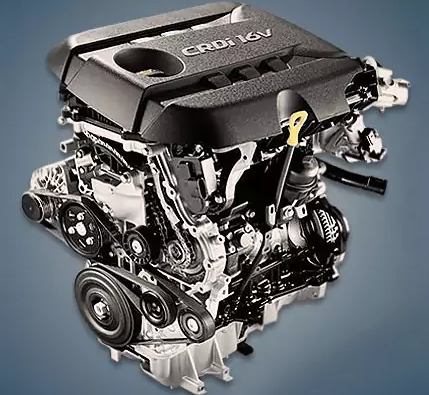
With a capacity of 1.7 liters, the biggest member of the U2 diesel family debuted in 2010. With a timing chain drive, an aluminum 16-valve DOHC head with hydraulic lifters, and a cast-iron cylinder block, it was a diesel engine that was considered classic at the time. A CR Bosch fuel system with a maximum pressure of up to 1800 bar handled the injection; a turbocharger with a Garrett GTB1244VZ geometry change system provided the boost; swirl flaps were installed in the intake manifold; and several models had a start-stop system. There were two versions that supported Euro 5: 116 horsepower and 260 Nm or 136 horsepower and 320 Nm.
The U2 family’s diesel engines were upgraded in 2015 to meet stricter Euro 6 economy requirements. A lower compression ratio—which was lowered from 17.0 to 15.7—can be used to identify these units. Both engine versions—116 horsepower and 280 Nm or 141 horsepower and 340 Nm—started to gain power.
The D3FA, D4FA, D4FB, D4FC, and D4FE engines are also part of the Hyundai U series.
The engine was mounted on:
- Hyundai i40 1 (VF) in 2011 – 2018;
- Hyundai ix35 1 (LM) in 2010 – 2015;
- Hyundai Sonata 7 (LF) in 2015 – 2019;
- Hyundai Tucson 3 (TL) in 2015 – 2018;
- Kia Optima 3 (TF) in 2012 – 2015; Optima 4 (JF) in 2015 – 2018;
- Kia Sportage 3 (SL) in 2010 – 2016; Sportage 4 (QL) in 2015 – 2018;
- Kia Carens 4 (RP) in 2013 – 2018.
Specifications
| Production years | 2010-2019 |
| Displacement, cc | 1685 |
| Fuel system | Common Rail |
| Power output, hp | 116 – 136 (EURO 5 versions) 116 – 141 (EURO 6 versions) |
| Torque output, Nm | 260 – 330 (EURO 5 versions) 280 – 340 (EURO 6 versions) |
| Cylinder block | cast iron R4 |
| Block head | aluminum 16v |
| Cylinder bore, mm | 77.2 |
| Piston stroke, mm | 90 |
| Compression ratio | 17.0 (EURO 5 versions) 15.7 (EURO 6 versions) |
| Hydraulic lifters | yes |
| Timing drive | chain |
| Turbocharging | yes |
| Recommended engine oil | 0W-30, 5W-30 |
| Engine oil capacity, liter | 5.7 |
| Fuel type | diesel |
| Euro standards | EURO 5 EURO 6 |
| Fuel consumption, L/100 km (for Hyundai i40 2014) — city — highway — combined |
7.8 5.0 6.0 |
| Engine lifespan, km | ~350 000 |
| Weight, kg | 167.7 |
Disadvantages of the Hyundai D4FD engine
The owner’s primary concerns are the swirl flap-equipped intake manifold’s quick contamination. Every 50,000 kilometers, it must be cleaned. They simply stop functioning when the damper actuator frequently flies off the hinges.
This power unit’s CR Bosch fuel system is very dependable—but only if you don’t fill the tank, which is particularly true for Euro 6 diesel engines. Frequently, their complaints are limited to the fuel pressure regulator and booster pump failures.
This engine comes with a particulate filter in every version, which can be inconvenient. An increase in lubrication indicates that it has already become clogged due to a failure in regeneration. Frequently, a leaky fuel pump seal allows fuel to get into the oil.
Timing chains extend to 100,000 kilometers for all U-series diesels, but they typically extend to 200,000 kilometers for 1.7-liter engines. It is important to remember that a strong stretch can cause the valves to bend and the chain to jump.
Only relatively frequent lubricant leaks are noteworthy among the other complaints on specialized forums. Additionally, the throttle flap and EGR valve need to be cleaned on a regular basis.