
Many of the company’s rear-wheel drive models, particularly those sold under the Genesis brand, are equipped with the 3.8-liter gasoline engine Hyundai G6DJ or Genesis 3.8 GDi, which has been manufactured since 2011. Executive class sedans like the Equus and Quoris also have this motor under the hood.
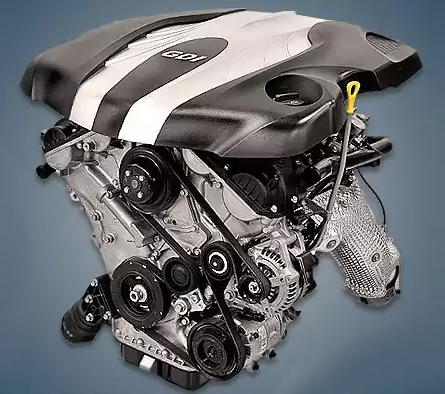
Lambda 3.8L family: G6DA, G6DJ, G6DK, and G6DN.
The engine was mounted on:
- Hyundai G80 1 (DH) in 2016 – 2020;
- Hyundai G90 1 (HI) since 2015;
- Hyundai Equus 2 (VI) in 2011 – 2016;
- Hyundai Genesis 1 (BH) in 2011 – 2014; Genesis 2 (DH) in 2013 – 2016;
- Hyundai Genesis Coupe 1 (BK) in 2012 – 2016;
- Kia Quoris 1 (KH) in 2012 – 2018;
- Kia K900 2 (RJ) since 2018.
Specifications
| Production years | since 2011 |
| Displacement, cc | 3778 |
| Fuel system | direct injection |
| Power output, hp | 311 – 353 |
| Torque output, Nm | 395 – 400 |
| Cylinder block | aluminum V6 |
| Block head | aluminum 24v |
| Cylinder bore, mm | 96 |
| Piston stroke, mm | 87 |
| Compression ratio | 11.5 |
| Features | VIS |
| Hydraulic lifters | no |
| Timing drive | chain |
| Phase regulator | Dual CVVT |
| Turbocharging | no |
| Recommended engine oil | 5W-30 |
| Engine oil capacity, liter | 6.9 (there are versions with a pallet of 5.7 liters) |
| Fuel type | petrol |
| Euro standards | EURO 5 |
| Fuel consumption, L/100 km (for Hyundai Genesis 2015) — city — highway — combined |
15.1 8.6 10.3 |
| Engine lifespan, km | ~320 000 |
| Weight, kg | 221 (with attachments) |
Disadvantages of the Hyundai G6DJ engine
First of all, carbon deposits on the intake valves are a problem for units with GDi injection; piston rings and the ensuing oil burner are also frequently found here;
The aluminum block keeps the cooling system from overheating, so keep it clean.
Additionally, since there are no hydraulic lifters here, remember to adjust the valve clearance. Timing chains can stretch on long runs, and replacing them will be costly.