
Both front-wheel drive Grandeur and rear-wheel drive ix55 models were equipped with the 3.8-liter gasoline V6 Hyundai G6DA engine, which was manufactured in the United States from 2004 to 2016. There were two generations of such a power unit, and they differed significantly.
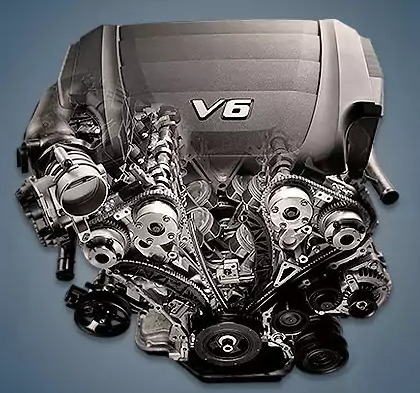
The Lambda I family of V6 engines debuted a 3.8-liter power unit in 2005. With an aluminum block and a 60° camber angle, two aluminum DOHC cylinder heads without hydraulic lifters, multiport fuel injection, a timing chain drive, and an intake manifold with a two-stage geometry change system, this is a very traditional V-engine. Only the intake shafts of the first generation unit had CVVT-type phase regulators installed.
The Lambda II, a second-generation 3.8-liter V6 power unit, made its debut in 2008. The engine was equipped with a contemporary plastic intake manifold with a three-stage geometry change system and a CVVT variable valve timing system already installed on all camshafts.
Lambda 3.8L family: G6DA, G6DJ, G6DK, and G6DN.
The engine was mounted on:
- Hyundai Entourage 1 (EP) in 2006 – 2009;
- Hyundai Equus 1 (LZ) in 2005 – 2008;
- Hyundai Grandeur 4 (TG) in 2005 – 2011;
- Hyundai ix55 1 (EN) in 2006 – 2015;
- Kia Carnival 2 (VQ) in 2005 – 2014;
- Kia Mohave 1 (HM) in 2008 – 2016;
- Kia Opirus 1 (GH) in 2005 – 2011;
- Kia Sorento 1 (BL) in 2006 – 2009.
Specifications
| Production years | 2004-2016 |
| Displacement, cc | 3778 |
| Fuel system | distributed injection |
| Power output, hp | 240 – 284 |
| Torque output, Nm | 343 – 369 |
| Cylinder block | aluminum V6 |
| Block head | aluminum 24v |
| Cylinder bore, mm | 96 |
| Piston stroke, mm | 87 |
| Compression ratio | 10.4 |
| Features | DOHC |
| Hydraulic lifters | no |
| Timing drive | chain |
| Phase regulator | CVVT |
| Turbocharging | no |
| Recommended engine oil | 5W-30, 5W-40 |
| Engine oil capacity, liter | 6.0 (there are versions with a 6.4 liter pallet) |
| Fuel type | petrol |
| Euro standards | EURO 3/4 |
| Fuel consumption, L/100 km (for Hyundai ix55 2010) — city — highway — combined |
17.6 9.1 12.2 |
| Engine lifespan, km | ~300 000 |
| Weight, kg | 215 (with attachments) |
Disadvantages of the Hyundai G6DA engine
The majority of the owners’ complaints are related to the oil burner in some way, and the thin oil scraper rings are the cause of this. Usually, decarbonizing doesn’t help; you still need to start the engine.
The liners frequently turn when the system’s lubrication level decreases as a result of the oil burner; numerous examples of these breakdowns can be found on specialized forums. Periodically serviced units, however, also wedge; it appears that the liners are not very strong in this area.
The timing chain has a limited lifespan—it occasionally lasts less than 150,000 kilometers—and replacing it can be costly, particularly if new phase regulators need to be purchased. The chains started to run longer on second-generation engines, but the hydraulic tensioner failed.
There are also frequent oil leaks from beneath the plastic valve covers, soot-induced throttle wedges, and intake geometry change system components that burst. Additionally, remember that the valve clearance needs to be adjusted every 60,000 kilometers.