
Popular models like the Optima, Sonata, Santa Fe, Sorento, and Sportage are equipped with the 2.4-liter Hyundai-Kia G4KJ or 2.4 GDi gasoline engine, which has been manufactured since 2009. A block of balancing shafts and a GDi direct injection system set this unit apart.
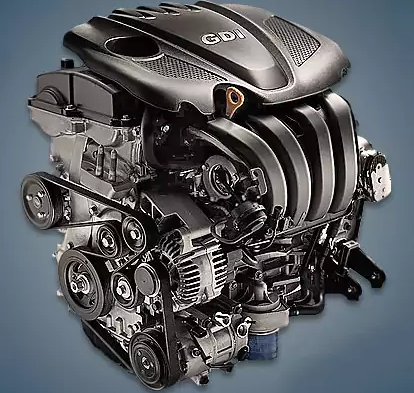
The American Hyundai Sonata YF and Kia Optima TF sedans introduced a new 2.4-liter Theta II engine with GDi direct fuel injection in 2010. With an aluminum cylinder block, cast-iron sleeves, an open cooling jacket, CVVT phase regulators on two shafts, a 16-valve head without hydraulic compensators, a timing chain, and VCM and VIS systems in the intake, this power unit is typical of the line in every other way. It has a block of balancer shafts, just like a lot of large displacement 4-cylinder engines.
The E-CVVT phase regulator on the intake camshaft and the addition of oil nozzles for cooling the pistons are the two primary innovations in this engine’s continuous upgrades.
G4KC, G4KE, G4KG, G4KJ, and G4KK are members of the Theta 2.4L family.
The engine was mounted on:
- Hyundai Grandeur 5 (HG) in 2011 – 2016; Grandeur 6 (IG) in 2016 – 2019;
- Hyundai Santa Fe 3 (DM) in 2012 – 2018; Santa Fe 4 (TM) in 2018 – 2020;
- Hyundai Sonata 6 (YF) in 2010 – 2015; Sonata 7 (LF) in 2014 – 2020;
- Hyundai Tucson 3 (TL) in 2015 – 2021;
- Kia Cadenza 1 (VG) in 2011 – 2016; Cadenza 2 (YG) in 2016 – 2019;
- Kia Optima 3 (TF) in 2010 – 2015; Optima 4 (JF) in 2015 – 2020;
- Kia Sorento 2 (XM) in 2012 – 2014; Sorento 3 (UM) in 2014 – 2020;
- Kia Sportage 4 (QL) in 2015 – 2021.
Specifications
| Production years | since 2009 |
| Displacement, cc | 2359 |
| Fuel system | direct injection |
| Power output, hp | 180 – 201 |
| Torque output, Nm | 231 – 251 |
| Cylinder block | aluminum R4 |
| Block head | aluminum 16v |
| Cylinder bore, mm | 88 |
| Piston stroke, mm | 97 |
| Compression ratio | 11.3 |
| Hydraulic lifters | no |
| Timing drive | chain |
| Phase regulator | yes |
| Turbocharging | no |
| Recommended engine oil | 5W-20, 5W-30 |
| Engine oil capacity, liter | 5.8 |
| Fuel type | petrol |
| Euro standards | EURO 5/6 |
| Fuel consumption, L/100 km (for Kia Sorento Prime 2016) — city — highway — combined |
12.9 7.5 9.4 |
| Engine lifespan, km | ~300 000 |
| Weight, kg | 128.4 |
Disadvantages of the Hyundai G4KJ engine
The most well-known issue with this engine is the wedge caused by the liners’ rotation, which is also the cause of the oil pump and balance shaft block’s quick wear. Such engines were the subject of a widespread recall campaign in the USA and South Korea.
Massive failures of the E-CVVT phase regulator prompted the second recall campaign. Usually, the only way to deal with it was to replace the cover that grease fell under.
Oil nozzles for cooling the pistons quickly appeared on these engines, and scuffing caused by catalyst crumb infiltration is uncommon. However, an aluminum block with thin cast-iron liners and an open cooling jacket quickly overheats, causing an ellipse of cylinders and oil consumption.
This engine, like all direct fuel injection engines, has soot on the valves. On specialized forums, people complain about the air conditioning compressor clutch bearing’s short lifespan and frequent lubricant leaks from under the valve cover or through the crankshaft oil seals.