
For passenger cars W123, W124, W201, and SUVs W460/461, Mercedes-Benz offers an inline 4-cylinder gasoline engine called the Mercedes M102. The engine debuted in 1980 as a replacement for the M115 series motors, and it was manufactured in various quantities and configurations up until 1996.
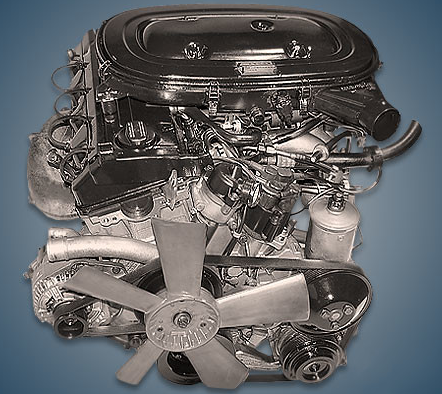
M102, M111, M133, M139, M166, M200, M254, M260, M264, M266, M270, M271, M274, and M282 are the R4 Mercedes engines.
Mercedes engines in the 102 series were created from the ground up. It comes with sports 2.5-liter engines, 1.8 and 2.3-liter engines, and 2.0-liter versions. Two different kinds of crankshafts were installed, and the cast iron cylinder block was rebuilt. There were no hydraulic valve clearances for the cylinder head with eight valves and one camshaft.
A double-row timing chain drive took its place in 1987 after the single-row chain drive gained notoriety as an unreliable and rapidly out-of-service component. The M102 E20 motor’s timing drive has an average service life of 150 thousand kilometers. The engine was modernized in 1984 with the addition of a crankshaft, lightweight connecting rods, hydraulic lifters, additional engine mounts, and an oil filter.
Specifications
| Production years | 1980-1993 |
| Displacement, cc | 1797 (M 102 E 18) 1996 / 1997 (M 102 E 20) 2298 / 2299 (M 102 E 23) |
| Fuel system | KE-Jetronic (M 102 E 18) carburetor / Jetronic (M 102 E 20) carburetor / Jetronic (M 102 E 23) |
| Power output, hp | 109 (M 102 E 18) 86 – 122 (M 102 E 20) 95 – 136 (M 102 E 23) |
| Torque output, Nm | 150 (M 102 E 18) 165 – 178 (M 102 E 20) 170 – 205 (M 102 E 23) |
| Cylinder block | cast iron R4 |
| Block head | aluminum 8v |
| Cylinder bore, mm | 89 (M 102 E 18) 89 (M 102 E 20) 95.5 (M 102 E 23) |
| Piston stroke, mm | 72.2 (M 102 E 18) 80.2 / 80.25 (M 102 E 20) 80.2 / 80.25 (M 102 E 23) |
| Compression ratio | 9.0 (M 102 E 18) 8.0 – 9.0 (M 102 E 20) 8.0 – 9.0 (M 102 E 23) |
| Features | no |
| Hydraulic lifters | yes (M 102 E 18) after 1984 (M 102 E 20) after 1984 (M 102 E 23) |
| Timing drive | chain |
| Phase regulator | no |
| Turbocharging | no |
| Recommended engine oil | 5W-40 |
| Engine oil capacity, liter | 5.0 (M 102 E 18) 4.5 / 5.0 (M 102 E 20) 4.5 / 5.0 (M 102 E 23) |
| Fuel type | petrol |
| Euro standards | EURO 0/1 |
| Fuel consumption, L/100 km (for Mercedes 190 2.0 E 1991) — city — highway — combined |
14.7 8.2 11.0 |
| Engine lifespan, km | ~400 000 |
| Weight, kg | 165 |
The engine was installed on:
- Mercedes C-Class W201 in 1982 – 1993;
- Mercedes E-Class W123 in 1980 – 1986; E-Class W124 in 1985 – 1992;
- Mercedes G-Class W460 in 1980 – 1989.
Disadvantages of the Mercedes M102 engine
Camshaft wear at 150,000 kilometers is the most well-known engine issue.
The oil burner comes in second, with valve stem seals being the most common cause.
When the power unit’s pillows are replaced, vibrations and knocks under the hood typically go away.
The new double-row timing chain is only marginally longer than the single-row timing chain.
The valves were changed every 10,000 kilometers and there were no hydraulic lifters until 1984.
8-valve carburetor versions
| Version | Model | Displacement | Piston stroke × Cylinder bore, mm | Power | Torque output | Production years |
| M102 V20 | 102.921 | 2,0 l. | 80,25 × 89 | 66 kW (90 hp) | 165 Nm | 1982–1984 |
| 102.938 | 63 kW (86 hp) | – | 1982–1984 | |||
| 102.924 | 77 kW (105 hp) | 170 Nm | 1984–1986 | |||
| 80 kW (109 hp) | 165 Nm | 1986–1988 | ||||
| 77 kW (105 hp) | 160 Nm | 1986–1988 | ||||
| 2,0 l. | 80,2 × 89 | 165 Nm | 1988–1989 | |||
| 75 kW (102 hp) | 160 Nm | 1988–1989 | ||||
| 75 kW (102 hp) | 158 Nm | 1989–1991 | ||||
| 102.920 | 2,0 l. | 80,25 × 89 | 80 kW (109 hp) | 170 Nm | 1980–1986 | |
| 102.939 | 74 kW (101 hp) | – | 1980–1985 | |||
| 102.922 | 80 kW (109 hp) | 170 Nm | 1985–1986 | |||
| 80 kW (109 hp) | 165 Nm | 1986–1989 | ||||
| 77 kW (105 hp) | 160 Nm | 1986–1990 | ||||
| 2,0 l. | 80,2 × 89 | 77 kW (105 hp) | 158 Nm | 1989–1990 | ||
| M102 V23 | 102.944 | 2,3 l. | 80,25 × 95,5 | 80 kW (109 hp) | 174 Nm | 1986–1989 |
| 102.942 /945 | 70 kW (95 hp) | 170 Nm | 1982–1989 | |||
| 102.946 | 77 kW (105 hp) | 182 Nm | 1989–1995 |
Injection 8-Valve Versions
| Version | Model | Displacement | Piston stroke × Cylinder bore, mm | Power | Torque output | Production years |
| M102 E18 | 102.910 | 1,8 l. | 72,2 × 89 | 80 kW (109 hp) | 150 Nm | 1990–1993 |
| M102 E20 | 102.962 | 2,0 l. | 80,25 × 89 | 90 kW (122 hp) | 178 Nm | 1982–1986 |
| 87 kW (118 hp) | 172 Nm | 1985–1988 | ||||
| 2,0 l. | 80,2 × 89 | 90 kW (122 hp) | 178 Nm | 1988–1991 | ||
| 87 kW (118 hp) | 172 Nm | 1988–1991 | ||||
| 90 kW (122 hp) | 175 Nm | 1991–1993 | ||||
| 102.963 | 2,0 l. | 80,25 × 89 | 90 kW (122 hp) | 178 Nm | 1985–1989 | |
| 87 kW (118 hp) | 172 Nm | 1985–1989 | ||||
| 2,0 l. | 80,2 × 89 | 87 kW (118 hp) | 172 Nm | 1989–1992 | ||
| 102.964 | 2,0 l. | 80,25 × 89 | 90 kW (122 hp) | 178 Nm | 1986–1991 | |
| 87 kW (118 hp) | 172 Nm | 1986–1991 | ||||
| 102.965 | 2,0 l. | 80,2 × 89 | 87 kW (118 hp) | 172 Nm | 1990–1994 | |
| M102 E23 | 102.961 | 2,3 l. | 80,25 × 95,5 | 83 kW (113 hp) | – | 1983–1984 |
| 102.985 | 2,3 l. | 80,2 × 95,5 | 87 kW (122 hp) | – | 1984–1986 | |
| 100 kW (136 hp) | 205 Nm | 1986–1991 | ||||
| 97 kW (132 hp) | 198 Nm | 1986–1991 | ||||
| 100 kW (136 hp) | 200 Nm | 1991–1993 | ||||
| 102.980 | 2,3 l. | 80,25 × 95,5 | 100 kW (136 hp) | 205 Nm | 1980–1986 | |
| 102.982 | 97 kW (132 hp) | 198 Nm | 1985–1989 | |||
| 2,3 l. | 80,2 × 95,5 | 97 kW (132 hp) | 198 Nm | 1989–1992 | ||
| 102.981 | 2,3 l. | 80,25 × 95,5 | 92 kW (125 hp) | 192 Nm | 1982–1985 | |
| 102.987 | 2,3 l. | 80,2 × 95,5 | 92 kW (125 hp) | 192 Nm | 1986–1991 | |
| 90 kW (122 hp) | 188 Nm | 1986–1991 | ||||
| 102.979 | 90 kW (122 hp) | 188 Nm | 1992–1996 | |||
| 102.989 | 93 kW (126 hp) | 190 Nm | 1990–1994 |
Injection 16 Valve Versions
| Version | Model | Displacement | Piston stroke × Cylinder bore, mm | Power | Torque output | Production years |
| M102 E23/2 | 102.983 | 2,3 l. | 80,25 × 95,5 | 136 kW (185 hp) | 235 Nm | 1983–1987 |
| 130 kW (177 hp) | 230 Nm | 1985–1988 | ||||
| 125 kW (170 hp) | 220 Nm | 1985–1988 | ||||
| M102 E25/2 | 102.990 | 2,5 l. | 87,2 × 95,5 | 150 kW (204 hp) | 240 Nm | 1988–1993 |
| 143 kW (195 hp) | 235 Nm | 1988–1993 | ||||
| 102.991 | 2,5 l. | 82,8 × 97,3 | 150 kW (204 hp) | 240 Nm | 1989 | |
| 143 kW (195 hp) | 235 Nm | 1989 | ||||
| 102.992 | 173 kW (235 hp) | 245 Nm | 1990 |