
From 1983 to 1994, the Japanese company produced the 1.8-liter Mitsubishi 4G37 engine, which was fitted to well-known models like the Lancer, Galant, and Eclipse. Both carburetor and ECI-MULTI injection versions of this power unit were available.
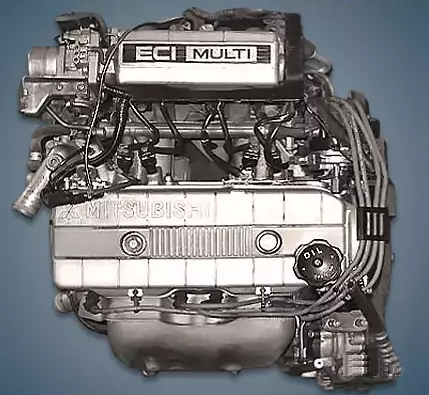
The 4G32 and 4G33 engines are also part of the 4G3 family.
The engine was mounted on:
- Mitsubishi Eclipse 1G in 1989 – 1994;
- Mitsubishi Galant E10 in 1983 – 1989;
- Mitsubishi Galant E30 in 1987 – 1993;
- Mitsubishi Lancer CV in 1987 – 1990;
- Mitsubishi Lancer CA in 1988 – 1992;
- Mitsubishi Space Wagon in 1983 – 1991.
Specifications
| Production years | 1983-1994 |
| Displacement, cc | 1755 |
| Fuel system | carburetor (4G37 carburetor) injector (4G37B ECI-multi) |
| Power output, hp | 86 (4G37 carburetor) 90 – 97 (4G37B ECI-multi) |
| Torque output, Nm | 137 (4G37 carburetor) 138 – 144 (4G37B ECI-multi) |
| Cylinder block | cast iron R4 |
| Block head | aluminum 8v |
| Cylinder bore, mm | 80.6 |
| Piston stroke, mm | 86 |
| Compression ratio | 9.0 (4G37 carburetor) 9.5 (4G37B ECI-multi) |
| Features | no |
| Hydraulic lifters | no |
| Timing drive | belt |
| Phase regulator | no |
| Turbocharging | no |
| Recommended engine oil | 5W-40 |
| Engine oil capacity, liter | 3.9 |
| Fuel type | petrol |
| Euro standards | EURO 0 (4G37 carburetor) EURO 1/2 (4G37B ECI-multi) |
| Fuel consumption, L/100 km (for Mitsubishi Galant 1990) — city — highway — combined |
10.3 6.1 7.9 |
| Engine lifespan, km | ~350 000 |
| Weight, kg | 135 |
Disadvantages of the Mitsubishi 4G37 engine
Timing belts and balancer shaft belts are the most problematic short-lived belts.
Oil seals frequently leak oil, which gets on the belts and shortens their lifespan;
The ignition system and electronic control unit failures rank second;
The contamination of the throttle or idle speed controller is the cause of the floating engine speed at idle;
Power unit supports are short-lived, and valve clearances need to be adjusted frequently.