
From 2020 to 2022, the German company produced the 4.0-liter bi-turbo Audi DCUE engine, which was fitted to the SQ7 and SQ8 crossovers until the new DWRB unit replaced it. For the Audi RS Q8, a more potent version of this engine has its own DHUB index.
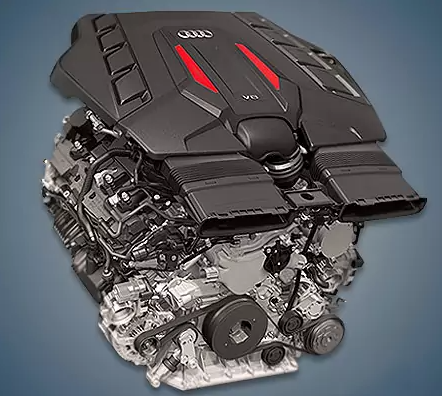
The EA825 series includes: CXYA, DCUE.
Specifications
| Production years | 2020-2022 |
| Displacement, cc | 3996 |
| Fuel system | direct injection |
| Power output, hp | 507 |
| Torque output, Nm | 770 |
| Cylinder block | aluminum V8 |
| Block head | aluminum 32v |
| Cylinder bore, mm | 86 |
| Piston stroke, mm | 86 |
| Compression ratio | 11.0 |
| Features | AVS |
| Hydraulic lifters | yes |
| Timing drive | chain |
| Phase regulator | on all shafts |
| Turbocharging | two BorgWarner B03G |
| Recommended engine oil | 0W-20 |
| Engine oil capacity, liter | 9.5 |
| Fuel type | petrol |
| Euro standards | EURO 6d-TEMP |
| Fuel consumption, L/100 km (for Audi SQ8 2021) — city — highway — combined |
13.8 6.8 11.8 |
| Engine lifespan, km | ~300 000 |
| Weight, kg | 231 |
The engine was installed on:
- Audi SQ7 2 (4M) in 2020 – 2022;
- Audi SQ8 1 (4M) in 2020 – 2022.
Disadvantages of the Audi DCUE engine
This turbo engine is dependable and has a long service life despite its complicated design;
Finding a unit that hasn’t undergone significant tuning is crucial, and there are plenty of them;
Additionally, monitor the quality of the gasoline; detonation-related piston destruction has already been reported;
Additionally, poor fuel is disliked by plasma spraying on the cylinder walls;
Turbine life is significantly shortened by oil savings and oil change intervals;
Carbon deposits and start-stop system malfunctions are additional issues.