
Since 2008, the company’s factories have been assembling the 2.0-liter Subaru EE20Z diesel engine, also known as EE20, which is installed on the European versions of many of the company’s models, most notably the Outback and Forester. Three versions of this motor are available to meet the eco-friendly EURO 4, 5, or 6 standards, respectively.
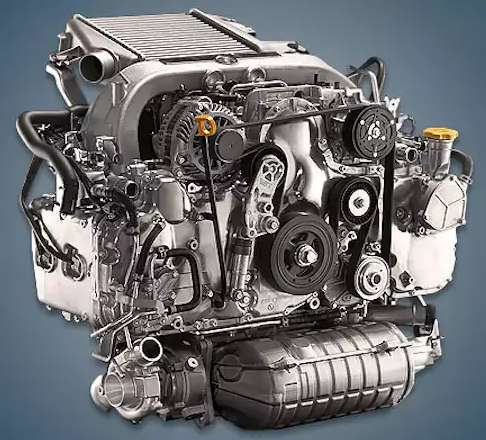
There is currently only one diesel engine in the EE family.
The engine was mounted on:
- Subaru Forester 3 (SH) in 2008 – 2013;
- Subaru Forester 4 (SJ) in 2012 – 2018;
- Subaru Forester 5 (SK) since 2018;
- Subaru Impreza 3 (GE) in 2009 – 2011;
- Subaru Legacy 5 (BM) in 2009 – 2014;
- Subaru Outback 4 (BR) in 2009 – 2014;
- Subaru Outback 5 (BS) in 2014 – 2020;
- Subaru XV 1 (GP) in 2011 – 2017.
Specifications
| Production years | since 2008 |
| Displacement, cc | 1998 |
| Fuel system | Common Rail |
| Power output, hp | 147 – 150 |
| Torque output, Nm | 350 |
| Cylinder block | aluminum H4 |
| Block head | aluminum 16v |
| Cylinder bore, mm | 86 |
| Piston stroke, mm | 86 |
| Compression ratio | 15.2 – 16.3 |
| Features | DOHC |
| Hydraulic lifters | no |
| Timing drive | chain |
| Phase regulator | no |
| Turbocharging | VGT |
| Recommended engine oil | 5W-30 |
| Engine oil capacity, liter | 5.6 |
| Fuel type | diesel |
| Euro standards | EURO 4/5/6 |
| Fuel consumption, L/100 km (for Subaru Forester 2015) — city — highway — combined |
7.0 4.9 5.7 |
| Engine lifespan, km | ~250 000 |
| Weight, kg | 190 |
Disadvantages of the EE20Z engine
The crankshaft in these units burst during the first few years of production because it was unable to support the load; the issue was resolved at the end of 2010 when an upgraded motor was introduced.
The exhaust cleaning system’s frequent vagaries are now the biggest annoyance. If you don’t replace the glow plugs on time, you’ll need to carefully drill them, and injectors can quickly fail here due to poor fuel, clogging the EGR valve.