
Popular company models like the Challenger, Charger, and Grand Cherokee are equipped with the 5.7-liter V8 Dodge EZH or HEMI 5.7 engine, which has been manufactured at the plant in Mexico since 2008. This engine has a variable valve timing system (VCT) and is part of an updated line.
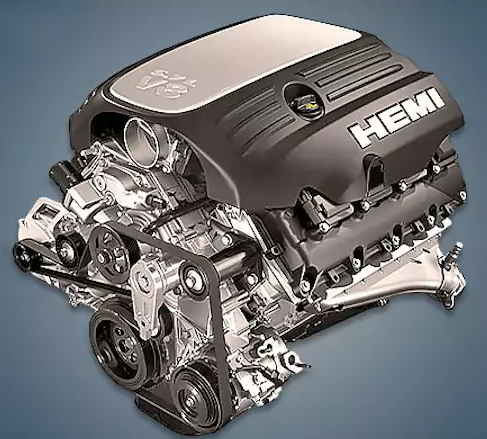
Internal combustion engines EZA, EZB, ESF, and ESG are also part of the HEMI series.
Long service life is one of the EZH engine’s key benefits. Therefore, the manufacturer claims that an internal combustion engine can travel at least 350 thousand kilometers without requiring a major overhaul if premium fuels and lubricants are used along with prompt consumable replacement.
Engineers used a chain in the timing system, which significantly extends the unit’s life and lowers the possibility of valve jams.
The engine was installed on:
- Chrysler 300C 1 (LX) in 2008 – 2010;
- Chrysler 300C 2 (LD) in 2011 – …;
- Dodge Charger 1 (LX) in 2008 – 2010;
- Dodge Charger 2 (LD) in 2011 – …;
- Dodge Challenger 3 (LC) in 2008 – …;
- Dodge Durango 3 (WD) in 2010 – …;
- Dodge Ram 4 (DS) in 2009 – …;
- Jeep Commander 1 (XK) in 2008 – 2010;
- Jeep Grand Cherokee 3 (WK) in 2008 – 2010;
- Jeep Grand Cherokee 4 (WK2) in 2010 – …
Specifications
| Production years | 2008-… |
| Cylinder block alloy | cast iron |
| Fuel system | injector |
| Configuration | V8 |
| Number of cylinders | 8 |
| Valves per cylinder | 2 |
| Block head | aluminum, 16v |
| Hydraulic lifters | yes |
| Timing drive | chain |
| Phase regulator | VCT |
| Turbocharging | no |
| Piston stroke, mm | 90.9 |
| Cylinder bore, mm | 99.5 |
| Compression ratio | 10.3 |
| Displacement, cc | 5654 |
| Power output, hp | 355 – 395 |
| Torque output, Nm | 525 – 555 |
| Fuel type | petrol |
| Euro standards | EURO 4 |
| Weight, kg | — |
| Fuel consumption, L/100 km (for Dodge Charger 2012) — city — highway — combined |
14.7 9.4 12.4 |
| Recommended engine oil | 5W-30 |
| Engine oil capacity, liter | 6.7 |
| Engine lifespan, km | ~350 000 |
Disadvantages of the EZH engine
These engines are fine in terms of dependability, but they use a lot of fuel;
Oil types 0W-20 and 5W-20 are preferred by hydraulic lifters and proprietary MDS systems;
The exhaust manifold frequently leads here, to the point where the studs of its fastening burst; low-quality fuel can quickly clog the EGR valve and cause it to stick;
Hemi ticking is the term for the odd noises that many owners hear.