
Diesel engines MAN of the D2848 series are 8-cylinder, 4-stroke internal combustion engines with direct fuel injection, turbocharging, and a V-shaped cylinder arrangement at a 90-degree angle. Additionally, the engine’s bearings are forced to be lubricated. Water is used to cool this motor.

The crankcase of the D 2848 engine is constructed from modified cast iron. Together with the cylinder block, these two components make up a single part. The engine has more rigidity because this block is pulled down. The engine has separate cylinder heads and wet, replaceable liners.
Specifications
| Engine’s type | V, diesel |
| Power output, hp (kW) | 900 (662) |
| Displacement, cc | 14618 |
| Number of cylinders | 8 |
| Valves | 16 |
| Compression ratio (compression) | 15,5:1 |
| Cylinder bore, mm | 128 |
| Piston stroke, mm | 142 |
| Crankshaft bearings | 5 |
| Fuel type | diesel |
| Turbine | turbo / charge air cooler |
| Cylinder head | OHV |
| Timing mechanism | spur gear |
| Timing | rocker arm |
| Cooling | water |
Main engine elements
The D2848 engine’s crankshaft is constructed in the traditional style with five bearings and a paired counterweight. Crankshaft oil seals have replaceable rotating O-rings and are radially sealed. Hot die forging is used to create camshaft connecting rods. Lead bronze, which has good antifriction qualities, is used to make the bearings in which the crankshaft and connecting rods rotate.
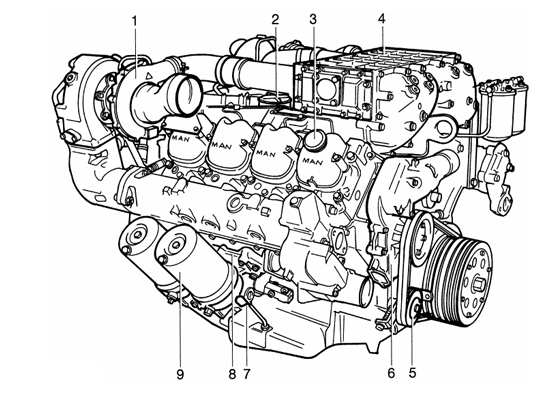
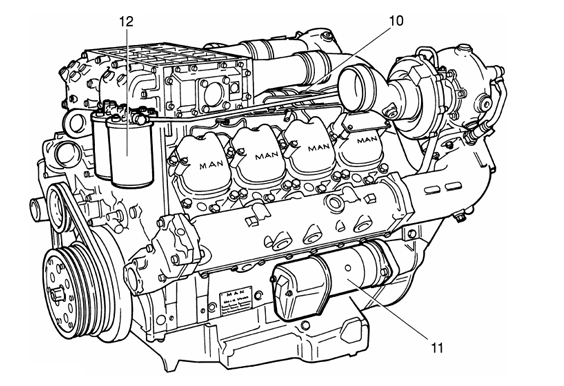
- Water-cooled charge air cooler;
- Oil separator valve for crankcase ventilation;
- Oil filler neck;
- Charge air cooler;
- Idler pulley;
- Water pump;
- Oil cooler;
- Oil separator valve for crankcase ventilation
- Oil filter;
- injection pump;
- Starter;
- Fuel filter.
Depending on the engine modification, a V-shaped camshaft with five to seven bearings is placed in the middle of the cylinder block. Gears power the camshaft drive, oil pump, and high pressure fuel pump. The camshaft opens the suspension valves above the cylinder by driving the rocker arms via the transmission elements. The transmission elements are pushers with a mushroom shape that are hardened by high frequency current and have a high surface hardness.
Depending on the model, the D2848’s circulating lubrication system uses one or two connected pumps. To clean the used oil, a double filter is installed in the system line. This system’s multiple circulation of oil from the sump to the main distribution pipeline via the oil cooler and filter is one of its features. Once inside the pipeline, the oil travels to:
- rocker arms;
- piston bushings;
- camshaft bearings;
- camshaft and cylinder drive gears;
- main connecting rod bearings.
Additionally, the high-pressure fuel pump and exhaust turbocharger receive oil from the circulation system. Spray oil is used to lubricate the aforementioned components. Gears from the crankshaft drive the high pressure in-line plunger pump.
After being cleaned and going through a double filter, fuel enters the injection pump chamber. The exhaust gases power the turbine wheels, which are firmly fixed on the turbocharger shaft. Excess pressure is produced when air is trapped and fed into the cylinders by the rotating compressor wheels. The circulating system provides the oil for this unit. A flange is used to secure a regulator to the injection pump’s front. Its job is to keep the crankshaft speed constant. The pump rack receives the force produced by the crankshaft’s rotation. Fuel delivery decreases as the frequency increases because of the increased centrifugal force. The frequency is automatically maintained.
The cylinders of the engine are supplied with water-cooled air. A water pump supplies the circuit with the chiller, which is a chilled water heat exchanger. The vane pump is powered by V-belts via the crankshaft pulley and features integrated thermostats. One housing houses both the expansion tank and the heat exchanger.
Explanation of marking MAN D2848
| D | The fuel that the engine runs on is diesel |
| 28 | Cylinder diameter, mm: 128 |
| 4 | Piston stroke, mm: 142 |
| 8 | Number of cylinders |