
From 2000 to 2005, Volkswagen produced the 1.0-liter 8-valve AUC 1.0 MPi engine, which was fitted to compact models like the Lupo and Polo as well as their Seat equivalents. In its family, this powertrain is the newest and most sophisticated.
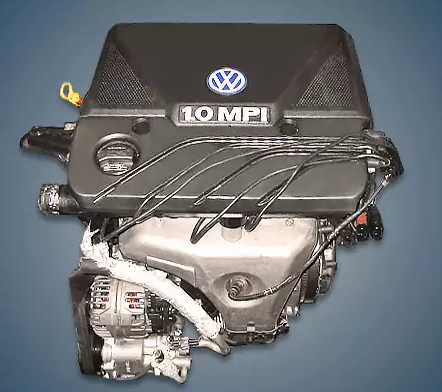
AER and AUC are part of the EA111-1.0 series.
Specifications
| Production years | 2000-2005 |
| Displacement, cc | 999 |
| Fuel system | injector |
| Power output, hp | 50 |
| Torque output, Nm | 86 |
| Cylinder block | aluminum R4 |
| Block head | aluminum 8v |
| Cylinder bore, mm | 67.1 |
| Piston stroke, mm | 70.6 |
| Compression ratio | 10.7 |
| Features | SOHC |
| Hydraulic lifters | yes |
| Timing drive | belt |
| Phase regulator | no |
| Turbocharging | no |
| Recommended engine oil | 5W-30 |
| Engine oil capacity, liter | 3.2 |
| Fuel type | petrol |
| Euro standards | EURO 3 |
| Fuel consumption, L/100 km (for VW Lupo 2002) — city — highway — combined |
7.4 4.6 5.6 |
| Engine lifespan, km | ~250 000 |
The engine was installed on:
- Seat Arosa 1 (6H) in 2000 – 2004;
- Seat Cordoba 1 (6K) in 2000 – 2002;
- Seat Ibiza 2 (6K) in 2000 – 2002;
- Volkswagen Lupo 1 (6X) in 2000 – 2005;
- Volkswagen Polo 3 (6N) in 2000 – 2001.
Disadvantages of the VW AUC engine
The owners of this dependable unit as a whole frequently worry about trivial matters.
Candles, coils, and high-voltage wires are the main issues with the ignition system.
The valves bend when the belt breaks, so it is important to keep a close eye on its condition.
The crankcase ventilation system frequently freezes in the winter, causing oil to press through the dipstick.
Antifreeze temperature sensors and camshaft position sensors frequently malfunction.