
From 1995 to 1999, the company’s factory assembled the 1.4-liter Volkswagen AEX engine, which was fitted to the third Golf, Polo, Caddy, and second generation Ibiza models. A revised version of this unit was also available under a different APQ index.
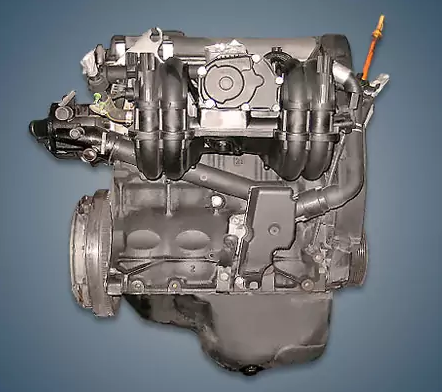
AEX, AKQ, AXP, BBY, BCA, BUD, CGGA, and CGGB are all part of the EA111-1.4 series.
Specifications
| Production years | 1995-1999 |
| Displacement, cc | 1390 |
| Fuel system | injector |
| Power output, hp | 60 |
| Torque output, Nm | 116 |
| Cylinder block | cast iron R4 |
| Block head | aluminum 8v |
| Cylinder bore, mm | 76.5 |
| Piston stroke, mm | 75.6 |
| Compression ratio | 10.2 |
| Features | SOHC |
| Hydraulic lifters | yes |
| Timing drive | belt |
| Phase regulator | no |
| Turbocharging | no |
| Recommended engine oil | 5W-30 |
| Engine oil capacity, liter | 3.2 |
| Fuel type | petrol |
| Euro standards | EURO 2 |
| Fuel consumption, L/100 km (for VW Golf 3 1997) — city — highway — combined |
9.0 5.5 6.8 |
| Engine lifespan, km | ~275 000 |
The engine was installed on:
- Volkswagen Caddy 2 (9K) in 1995 – 1999;
- Volkswagen Golf 3 (1H) in 1995 – 1999;
- Volkswagen Polo 3 (6N) in 1995 – 1999;
- Seat Ibiza 2 (6K) in 1996 – 1999.
Disadvantages of the VW AEX engine
Although this power unit is easy to use and dependable, maintaining it is not very convenient.
Oil leaks from beneath the valve covers are the most well-known engine issue.
The valves always bend when the timing belt breaks, which is a well-known unstable resource.
Floating idle is typically caused by throttle fouling.
Owners must deal with rings and oil burners on long runs.