
From 2008 to 2015, the company produced the 1.8-liter Volkswagen CDAA 1.8 TSI engine, which was fitted on numerous well-known company models, including the Golf, Passat, Octavia, and Audi A3. The history of the oil burner in TSI type motors started with this generation of power units.
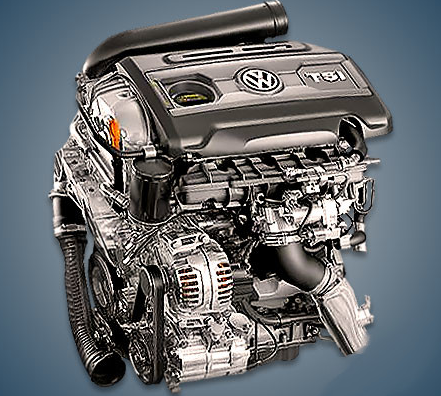
CDAA, CDAB, CDHA, CDHB, CCZA, CCZB, CCZC, CCZD, CDNB, CDNC, CAEA, and CAEB are all part of the EA888 gen2 series.
Specifications
| Production years | 2008-2015 |
| Displacement, cc | 1798 |
| Fuel system | direct injection |
| Power output, hp | 160 |
| Torque output, Nm | 250 |
| Cylinder block | cast iron R4 |
| Block head | aluminum 16v |
| Cylinder bore, mm | 82.5 |
| Piston stroke, mm | 84.2 |
| Compression ratio | 9.6 |
| Features | DOHC |
| Hydraulic lifters | yes |
| Timing drive | chain |
| Phase regulator | on the intake shaft |
| Turbocharging | KKK K03 |
| Recommended engine oil | 5W-30 |
| Engine oil capacity, liter | 4.6 |
| Fuel type | petrol |
| Euro standards | EURO 5 |
| Fuel consumption, L/100 km (for VW Passat B7 2011) — city — highway — combined |
9.8 5.5 7.1 |
| Engine lifespan, km | ~250 000 |
| Weight, kg | 144 |
The engine was installed on:
- Audi A3 2 (8P) in 2009 – 2013;
- Audi TT 2 (8J) in 2008 – 2014;
- Seat Altea 1 (5P) in 2009 – 2015;
- Seat Leon 2 (1P) in 2009 – 2012;
- Seat Toledo 3 (5P) in 2008 – 2009;
- Skoda Octavia 2 (1Z) in 2008 – 2013;
- Skoda Superb 2 (3T) in 2008 – 2013;
- Skoda Yeti 1 (5L) in 2009 – 2015;
- Volkswagen Golf 6 (5K) in 2009 – 2010;
- Volkswagen Passat CC (35) in 2008 – 2012;
- Volkswagen Passat B6 (3C) in 2008 – 2010; Passat B7 (36) in 2010 – 2012.
Disadvantages of the VW CDAA engine
The most well-known issue with this motor is the oil burner because of rings.
The unreliable timing chain, which has a maximum length of 100,000 kilometers, comes in second.
Engine coking and floating speeds are caused by increased oil consumption.
You will probably need to replace the ignition coils if you pull with the candle replacement.
Another low resource is the high-pressure fuel pump, which starts passing gasoline into the oil.