
Since 2014, the BMW B47 2.0-liter 4-cylinder diesel engine series has been put together. It is fitted to cars with front-wheel drive (B47C20), rear-wheel drive (B47D20), and Mini (B47C20A). There are two generations of these motors, and the most recent iteration is known as B47TU1.
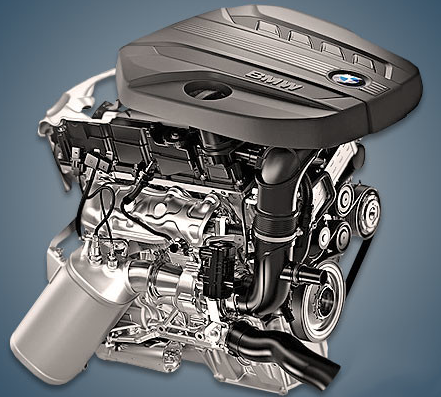
New B47 engines from the modular family took the place of the N47 series diesel engines in 2014. Among their design elements are an aluminum cylinder block with a closed jacket, a timing chain drive, and an aluminum 16-valve cylinder head with hydraulic lifters. The CR Bosch system performs the injection, which varies according to the motor’s version: the older models use piezo injectors, while the more recent models use electromagnetic injectors. Additionally, the older engine already has two turbines, while the newer models have a Garrett GTD1752VRK turbocharger.
The diesel engines in this family were updated in 2017 and are now known as B47TU1. All units now have BorgWarner R2S twin turbocharging, not just the older models; all engines have electromagnetic injectors, not just the newer models; and, depending on the version, the injection pressure has been increased from 2000–2500 bar to 2500–2700 bar. A sophisticated exhaust purification system with AdBlue injection was also added to the upgraded engines.
Front-wheel drive engine modifications:
- B47C20U0 (150 hp / 330 Nm) installed on BMW 2-Series F45 in 2014 – 2018, 2-Series F46 in 2015 – 2018, X1 F48 since 2015;
- B47C20U1 (150 hp / 350 Nm) installed on BMW 1-Series F40 since 2019, 2-Series F44 since 2020, 2-Series F45 in 2018 – 2021, 2-Series F46 since 2018, X2 F39 since 2018;
- B47C20O0 (190 hp / 400 Nm) installed on BMW 2-Series F45 in 2014 – 2018, 2-Series F46 in 2015 – 2018, X1 F48 since 2015;
- B47C20O1 (190 hp / 400 Nm) installed on BMW 1-Series F40 since 2019, 2-Series F44 since 2020, 2-Series F45 in 2018 – 2021, 2-Series F46 since 2018, X2 F39 since 2018;
- B47C20T0 (231 hp / 450 Nm) installed on BMW X1 F48 since 2015, X2 F39 since 2018.
Rear-wheel drive engine modifications:
- B47D20K0 (116 hp / 270 Nm) installed on BMW 3-Series F30 in 2015 – 2018;
- B47D20U0 (150 hp / 320 Nm) installed on BMW 1-Series F20 in 2015 – 2019, 2-Series F22 in 2015 – 2020, 3-Series F30 in 2015 – 2018, 3-Series F34 in 2015 – 2020, 4-Series F32 in 2015 – 2017, 5-Series F10* in 2014 – 2017, X3 F25* in 2014 – 2017 (*on 5-Series and X3 models, the engine develops 150 hp and 360 Nm);
- B47D20U1 (150 hp / 350 Nm) installed on BMW 3-Series G20 since 2019, 5-Series G30 since 2018, X3 G01 since 2017;
- B47D20O0 (190 hp / 400 Nm) installed on BMW 1-Series F20 in 2015 – 2019, 2-Series F22 in 2014 – 2020, 3-Series F30 in 2015 – 2018, 3-Series F34 in 2015 – 2020, 4-Series F32 in 2015 – 2020, 5-Series F10 in 2014 – 2017, X3 F25 in 2014 – 2017, X4 F26 in 2014 – 2018;
- B47D20O1 (190 hp / 400 Nm) installed on BMW 3-Series G20 since 2019, 4-Series G22 since 2020, 5-Series G30 since 2017, 6-Series G32 since 2018, X3 G01 since 2017, X4 G02 since 2018;
- B47D20T0 (224 hp / 450 Nm) installed on BMW 1-Series F20 in 2015 – 2019, 2-Series F22 in 2015 – 2019, 3-Series F30 in 2015 – 2018, 4-Series F32 in 2016 – 2017, X5 F15* in 2015 – 2018 (*on the X5 model, this engine develops 231 hp and 500 Nm);
- B47D20T1 (231 hp / 500 Nm) installed on BMW 5-Series G30 in 2017 – 2019, X3 G01 in 2018 – 2019, X4 G02 in 2018 – 2019, X5 G05* since 2019 (*on the X5 model, this engine develops 231 hp and 450 Nm).
Specifications
| Production years | since 2014 |
| Displacement, cc | 1995 |
| Fuel system | Common Rail |
| Power output, hp | 116 – 231 |
| Torque output, Nm | 270 – 500 |
| Cylinder block | aluminum R4 |
| Block head | aluminum 16v |
| Cylinder bore, mm | 84 |
| Piston stroke, mm | 90 |
| Compression ratio | 16.5 |
| Hydraulic lifters | yes |
| Timing drive | chain |
| Fuel type | diesel |
| Euro standards | EURO 5/6 |
| Engine lifespan, km | ~350 000 |
Disadvantages of the B47C20/B47D20 engine
The EGR system, which is referred to as AGR in this context, is the main cause of the engine’s issues. Early on, a recall campaign was implemented because the valve could clog at 30,000 kilometers. The intake manifold overheats and bursts when it is jammed in the open position.
Pollution of the intake manifold and channels in the block head, which causes traction loss and unstable engine operation, ranks second in terms of the frequency of calls to the service station. The intake swirl flaps may jam and break off in the most severe situations.
Timing chains on B-series engines typically last much longer than those on N-series engines, but they can extend up to 200,000 kilometers when used excessively. A budgetary process for changing these chains without taking the power unit out already exists.
These engines, like all contemporary diesel engines, need high-quality fuel, upkeep, and consumables to avoid numerous Common Rail system issues. A particulate filter and an exhaust cleaning system can also cause you a lot of problems.