
From 2000 to 2014, a Korean plant produced the 2.5-liter Chevrolet X25D1 or LF4 engine, which was fitted to comparatively large concern models like the Epica and Evanda. Daewoo and Porsche collaborated to develop the XK-6 series of six-cylinder vehicles.
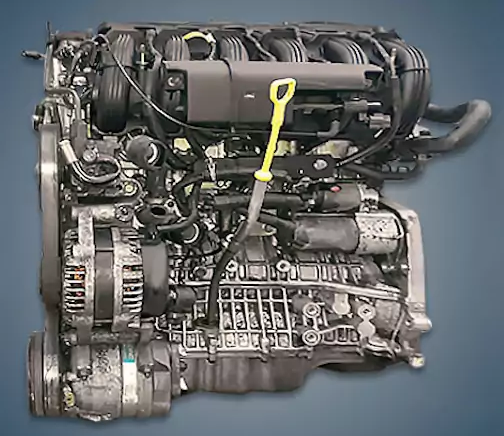
VIS is one of the engine’s features. This is the intake geometry change system, also known as the variable intake system. The intake manifold’s length was altered using a technique.
The X20D1 is another engine in the X series.
Specifications
| Production years | 2000-2014 |
| Displacement, cc | 2492 |
| Fuel system | distributed injection |
| Power output, hp | 155 |
| Torque output, Nm | 237 |
| Cylinder block | cast iron R6 |
| Block head | aluminum 24v |
| Cylinder bore, mm | 77 |
| Piston stroke, mm | 89.2 |
| Compression ratio | 9.8 |
| Features | VIS |
| Hydraulic lifters | yes |
| Timing drive | chain |
| Phase regulator | no |
| Turbocharging | no |
| Recommended engine oil | 5W-30 |
| Engine oil capacity, liter | 6.5 |
| Fuel type | petrol |
| Euro standards | EURO 3/4 |
| Fuel consumption, L/100 km (for Chevrolet Epica 2010) — city — highway — combined |
13.8 6.6 9.3 |
| Engine lifespan, km | ~260 000 |
The engine was installed on:
- Chevrolet Evanda V200 in 2000 – 2006;
- Chevrolet Epica V250 in 2006 – 2014;
- Daewoo Magnus V200 in 2000 – 2006;
- Daewoo Tosca V250 in 2006 – 2013.
Disadvantages of the X25D1 engine
The most well-known engine failure is when the oil pump’s wedge causes the liners to crank;
The walls of the cylinders are scratched by the crumbs of the collapsing catalyst;
The development of rings and the deterioration of valve seals are additional causes of oil burning.
Here, the cooling system causes numerous issues: either the tank will burst or the pipes will not flow;
The power unit’s crankcase frequently cracks after the drain plug is overtightened; cylinder walls’ aluminum coating may start to deteriorate at 100,000 kilometers;
The hydraulic lifters, generator, and oil pressure sensor have limited resources.