
From 1990 to 2005, the 3.8-liter compressor V6 engine GM L67 was manufactured in Michigan and fitted to charged Buick Park Avenue, Pontiac Bonneville, and Chevrolet Monte Carlo models. The device comes in two versions: Series I, which has 205–225 horsepower, and Series II, which has 240 horsepower.
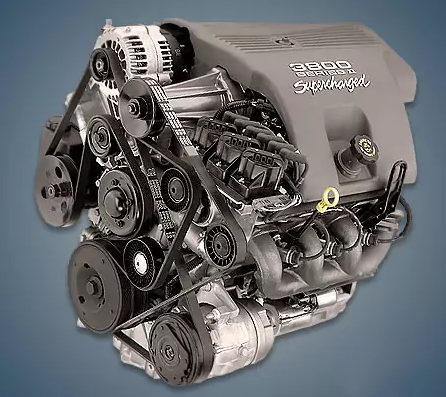
Buick V6 engine family: L32, L36, L67.
Specifications
| Production years | 1990 – 2005 |
| Displacement, cc | 3791 |
| Fuel system | distributed injection |
| Power output, hp | 205 – 225 (Series I, 1990 – 1995) 240 (Series II, 1995 – 2005) |
| Torque output, Nm | 353 – 373 (Series I, 1990 – 1995) 380 (Series II, 1995 – 2005) |
| Cylinder block | cast iron V6 |
| Block head | cast iron 12v |
| Cylinder bore, mm | 97 |
| Piston stroke, mm | 86 |
| Compression ratio | 8.0 (Series I, 1990 – 1995) 8.5 (Series II, 1995 – 2005) |
| Features | OHV |
| Hydraulic lifters | yes |
| Timing drive | chain |
| Phase regulator | no |
| Turbocharging | Eaton M62 (Series I, 1990 – 1995) Eaton M90 (Series II, 1995 – 2005) |
| Recommended engine oil | 5W-30 |
| Engine oil capacity, liter | 4.3 |
| Fuel type | petrol |
| Euro standards | EURO 1 (Series I, 1990 – 1995) EURO 2/3 (Series II, 1995 – 2005) |
| Fuel consumption, L/100 km (for Buick Park Avenue 2000) — city — highway — combined |
12.4 8.4 10.7 |
| Engine lifespan, km | ~250 000 |
| Weight, kg | 204 |
The engine was installed on:
- Buick Park Avenue 1 (C-body) in 1990 – 1996; Park Avenue 2 (G-body) in 1996 – 2005;
- Buick Regal 4 (W-body) in 1997 – 2004;
- Buick Riviera 8 (G-body) in 1995 – 1998;
- Chevrolet Impala 8 (GMX210) in 2003 – 2004;
- Chevrolet Monte Carlo 6 (GMX230) in 2003 – 2004;
- Oldsmobile 88 X (H-body) in 1995 – 1999;
- Oldsmobile 98 XII (C-Body) in 1991 – 1995;
- Pontiac Bonneville 9 (H-body) in 1991 – 1999; Bonneville 10 (GMX310) in 1999 – 2003;
- Pontiac Grand Prix 7 (W-body) in 1996 – 2003.
Disadvantages of the GM L67 engine
We start by pointing out that these engines come in two generations: Series I and Series II.
Compressor bearings in first-generation motors are notorious for having a short lifespan.
Balancer bearings and valve stem seals are additional weak points in this situation.
An incredibly unsuccessful plastic intake manifold was installed in the engines of the second generation.
This manifold’s gasket frequently leaks, allowing the antifreeze to combine with the oil.
Additionally, both generations’ units are terrified of overheating to the point of head cracking.