
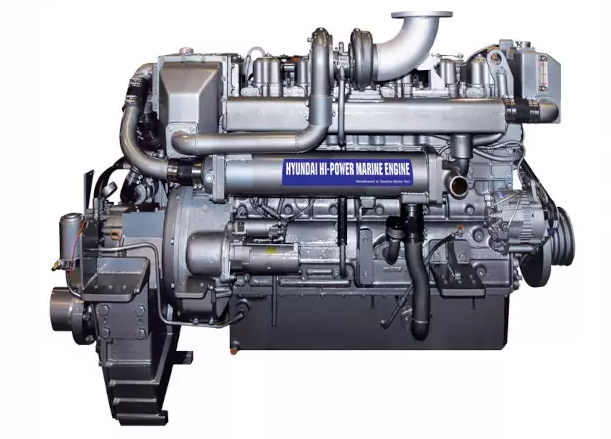
The well-known Hyundai and Mitsubishi trucks and buses are built with D6AC engines.
These businesses’ transportation has long been in high demand since it satisfies the primary needs for this type of equipment:
- reliability;
- economy;
- comfort;
- long service life.
In the domestic market, Hyundai trucks and buses are typically found with in-line diesel engines with four or six cylinders and a turbocharger. Eight-cylinder engines are far less prevalent.
With a volume of 11149 cm³, the D6AC is an in-line 6-cylinder diesel engine that can produce between 148 and 340 horsepower depending on the modification. A turbocharger is part of the kit.
Specifications
| Installed | Hyundai HD270, HD320/370 and HD500 |
| Also called | D6AC |
| Configuration | inline |
| Number of cylinders | 6 |
| Piston stroke, mm | 140 |
| Cylinder bore, mm | 130 |
| Compression ratio | 16.5 |
| Displacement, cc | 11149 |
| Power output, hp | 340/2200 |
| Torque output, Nm / rpm | 140/1400 |
| Weight, kg | 990 |
The D6AC engine is in high demand because of its excellent quality, affordability, dependability, and environmental friendliness. An additional benefit of the motor is its economical fuel and lubricant consumption. An electronic starter is responsible for the lightning-fast start, and the fuel that enters the working chamber is burned instantly.
Additionally, the D6AC engine is characterized by a low noise level and virtually no vibration. Pistons, bushings, connecting rods, liners, and other engine parts are all made with the newest, most advanced machinery.
The longer the engine can run, the better it is to keep an eye on it, replace worn-out or burned-out parts on time, and perform routine inspections.