
From 1986 to 2007, a Japanese factory assembled the Toyota 3S-GTE 2.0-liter turbo engine, which was used in sports modifications of popular models like the Celica and Caldina.
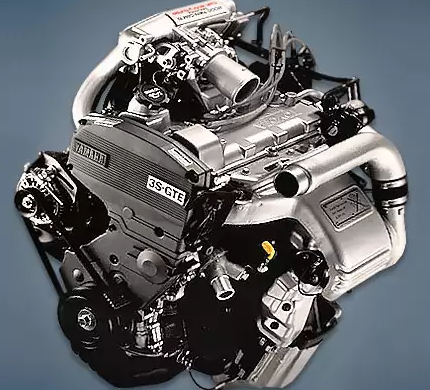
A 3S-GE-based turbo engine made its debut on the Celica model’s fourth generation in 1986. It was an intriguing device that combined a 16-valve aluminum cylinder head created by Yamaha engineers with the traditional 4-cylinder in-line cast-iron block. The timing drive was powered by a belt that had to rotate the water pump and the oil pump in addition to two camshafts. The valves here need to be adjusted, and there are no hydraulic lifters.
There are five distinct generations of this type of engine, the last two of which are nearly identical:
- From 1986 to 1989, only the Celica ST165 model was equipped with the first generation of the motor. It made use of an intake manifold with a T-VIS system and a CT26 turbine in a single housing. This power unit produced 185–190 horsepower and 250–260 Nm with pistons for an 8.5 compression ratio.
- The MR2 SW20 from 1990 to 1995 and the Celica ST185 from 1989 to 1993 both had the second generation installed. In this instance, the CT26 turbine was utilized in a double case while maintaining the intake with the T-VIS system. The power varied from 200 to 235 horsepower and from 270 to 305 Nm, and the compression ratio was increased to 8.8.
- From 1994 to 1999, the Celica ST205 and MR2 SW20 models were equipped with the third generation of the engine. The T-VIS system was removed from the motor, a CT20b turbine was installed, and the flow meter was swapped out for a MAP sensor. The power unit’s power was increased to 245 horsepower and 305 Nm while the compression ratio was once more lowered to 8.5.
- From 1997 to 2001, the fourth generation of this motor was mounted in the rear of the ST215 on the Caldina GT-T. A contemporary ignition system and a brand-new CT15B turbine have already been installed, along with the exhaust. The power unit’s power increased to 260 horsepower and 325 Nm, and the compression ratio rose to 9.0.
- From 2002 to 2007, only the Caldina GT-Four had the fifth generation installed in the rear of the ST246. This version, which is frequently referred to as “four and a half,” did not significantly differ from the previous one. Additional nozzles, intake manifold, ignition coils, and a smaller intercooler are all present. The engine power, which is 260 horsepower and 325 Nm, has not changed due to the compression ratio.
The engines in the S family are 4S-Fi, 4S-FE, 3S-FC, 3S-FE, 3S-FSE, 3S-GE, 3S-GTE, and 5S-FE.
The engine was mounted on:
- Toyota Caldina 2 (T210) in 1997 – 2001; Caldina 3 (T240) in 2002 – 2007;
- Toyota Celica 4 (T160) in 1986 – 1989; Celica 5 (T180) in 1989 – 1993; Celica 6 (T200) in 1993 – 1999;
- Toyota MR2 2 (W20) in 1990 – 1999.
Specifications
| Production years | 1986-2007 |
| Displacement, cc | 1998 |
| Fuel system | injector |
| Power output, hp | 185 – 235 (T-VIS ver. / 1st, 2nd gen.) 245 – 260 (3rd, 4th, 5th gen.) |
| Torque output, Nm | 250 – 305 (T-VIS ver. / 1st, 2nd gen.) 300 – 325 (3rd, 4th, 5th gen.) |
| Cylinder block | cast iron R4 |
| Block head | aluminum 16v |
| Cylinder bore, mm | 86 |
| Piston stroke, mm | 86 |
| Compression ratio | 8.5 – 8.8 (T-VIS ver. / 1st, 2nd gen.) 8.5 – 9.0 (3rd, 4th, 5th gen.) |
| Hydraulic lifters | no |
| Timing drive | belt |
| Recommended engine oil | 5W-30, 5W-40 |
| Engine oil capacity, liter | 3.9 4.2 |
| Fuel type | petrol |
| Euro standards | EURO 2 (T-VIS ver. / 1st, 2nd gen.) EURO 3 (3rd, 4th, 5th gen.) |
| Fuel consumption, L/100 km (for Toyota Caldina GT-T 2000) — city — highway — combined |
12.9 8.2 9.6 |
| Engine lifespan, km | ~300 000 |
| Weight, kg | 180 |
Disadvantages of the 3S-GTE engine
Like any turbo engine, this one depends on the oil’s quality and how often it needs to be changed; otherwise, a fully dependable turbine’s lifespan could be limited to 30 to 50 thousand kilometers.
Oil consumption of up to a liter per 1000 kilometers is typical at high mileage. The wear of the valve stem seals or the presence of piston rings is always the problem.
The timing belt has a high risk of breaking because it must turn both the pump and the oil pump in addition to two camshafts. The fact that the valves typically do not bend is advantageous.
Small malfunctions include: oil frequently seeps out from under the valve cover; engine speed floats because of throttle or EGR contamination; engine mounts deteriorate rapidly; ignition system parts frequently malfunction; and a variety of sensors malfunction. The valves must be changed every 100,000 kilometers, and there are no hydraulic lifters.