
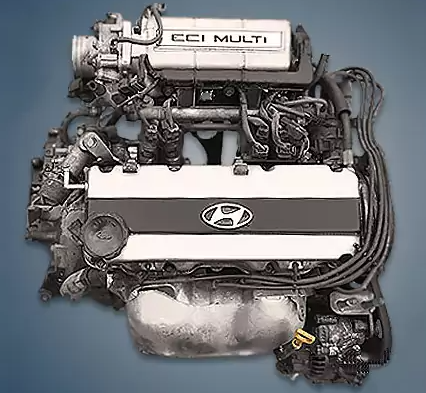
Due to its structural similarity to the well-known Japanese company engine with the 4G62 index, the 1.8-liter Hyundai G4CM engine was manufactured under license from Mitsubishi from 1988 to 1998. The base drivetrain of the Sonata Y2 and Y3 models is this SOHC engine.
Sirius family: G4CR (1.6 L); G4CN, G4CM, G4JN (1.8 L); G4CP, G4JP (2.0 L); G4JS, G4CS (2.4 L).
The engine was mounted on:
- Hyundai Sonata 2 (Y2) in 1988 – 1993; Sonata 3 (Y3) in 1993 – 1998.
Specifications
| Production years | 1988-1998 |
| Displacement, cc | 1795 |
| Fuel system | injector |
| Power output, hp | 90 – 100 |
| Torque output, Nm | 135 – 145 |
| Cylinder block | cast iron R4 |
| Block head | aluminum 8v |
| Cylinder bore, mm | 80.6 |
| Piston stroke, mm | 88 |
| Compression ratio | 8.8 – 8.9 |
| Features | no |
| Hydraulic lifters | yes |
| Timing drive | belt |
| Phase regulator | no |
| Turbocharging | no |
| Recommended engine oil | 10W-40 |
| Engine oil capacity, liter | 3.7 |
| Fuel type | petrol |
| Euro standards | EURO 1/2 |
| Fuel consumption, L/100 km (for Hyundai Sonata 1990) — city — highway — combined |
10.6 6.4 8.5 |
| Engine lifespan, km | ~300 000 |
| Weight, kg | 149.1 (without attachments) |
Disadvantages of the Hyundai G4CM engine
A loud clatter beneath the hood indicates that the hydraulic lifters are failing;
Critical wear of one of the engine mounts is indicated by vibration of the power unit;
Contamination of the injectors, throttle, and idle speed controller is frequently the cause of floating engine speeds;
These are all insignificant, though, and the most important thing is to keep an eye on the belts’ timing and balancers. If any of them break, it almost always results in a collision between pistons and valves.