
Since 2015, the 2.0-liter Land Rover 204DTD diesel engine has been manufactured in the UK and is found in nearly all of the company’s current models, including the Discovery Sport, Evoque, and Velar. This unit is referred to by its own index, AJ200D, on Jaguar vehicles.
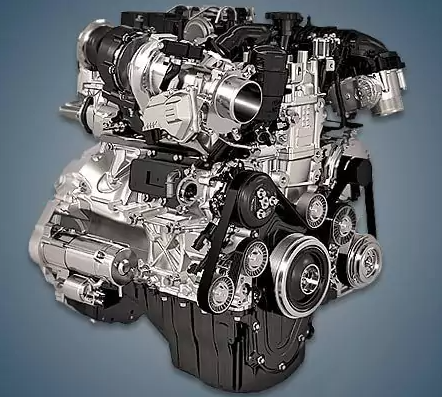
Engines from the Ingenium series: PT204, 204DTA, and 204DTD.
Specifications
| Production years | since 2015 |
| Displacement, cc | 1999 |
| Fuel system | Common Rail |
| Power output, hp | 150 – 180 |
| Torque output, Nm | 380 – 430 |
| Cylinder block | aluminum R4 |
| Block head | aluminum 16v |
| Cylinder bore, mm | 83 |
| Piston stroke, mm | 92.35 |
| Compression ratio | 15.5 |
| Features | intercooler |
| Hydraulic lifters | yes |
| Timing drive | chain |
| Phase regulator | no |
| Turbocharging | Mitsubishi TD04 |
| Recommended engine oil | 0W-30 |
| Engine oil capacity, liter | 6.5 |
| Fuel type | diesel |
| Euro standards | EURO 6 |
| Fuel consumption, L/100 km (for Range Rover Evoque 2017) — city — highway — combined |
5.8 4.4 4.9 |
| Engine lifespan, km | ~250 000 |
| Weight, kg | 130 |
The engine was installed on:
- Land Rover Discovery 5 (L462) in 2017 – 2018;
- Land Rover Discovery Sport 1 (L550) since 2015;
- Land Rover Range Rover Evoque 1 (L538) in 2015 – 2019; Evoque 2 (L551) since 2019;
- Land Rover Range Rover Velar 1 (L560) since 2017.
Disadvantages of the Land Rover 204DTD engine
Although the engine was only recently manufactured, it is already known to have a low resource;
The balancer bearings in the early engines rapidly deteriorated and started to buzz;
The timing chain is situated on the flywheel side and frequently covers less than 150,000 kilometers;
Cast-iron sleeves are prone to wear and sagging after more than 200,000 kilometers;
The particulate filter and the EGR valve are the remaining issues with this diesel.