
From 2008 to 2013, the company produced the 2.2-liter Mazda R2AA diesel engine, which was used in the CX-7 crossover and popular models like the third and sixth series. Under the R2BF index, this diesel engine’s power was lowered to 125 horsepower.
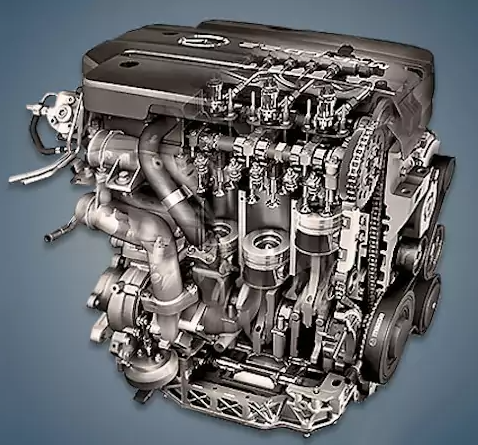
The RF5C and RF7J diesel engines are also part of the MZR-CD family.
The engine was mounted on:
- Mazda 3 BL in 2009 – 2013;
- Mazda 6 II (GH) in 2008 – 2012;
- Mazda CX-7 I (ER) in 2009 – 2012.
Specifications
| Production years | 2008-2013 |
| Displacement, cc | 2184 |
| Fuel system | Common Rail |
| Power output, hp | 150 – 185 |
| Torque output, Nm | 360 – 400 |
| Cylinder block | cast iron R4 |
| Block head | aluminum 16v |
| Cylinder bore, mm | 86 |
| Piston stroke, mm | 94 |
| Compression ratio | 16.3 |
| Features | DOHC, balancers |
| Hydraulic lifters | no |
| Timing drive | chain |
| Phase regulator | no |
| Turbocharging | IHI VJ42 |
| Recommended engine oil | 5W-30 |
| Engine oil capacity, liter | 4.7 |
| Fuel type | diesel |
| Euro standards | EURO 4/5 |
| Fuel consumption, L/100 km (for Mazda 6 2010) — city — highway — combined |
6.9 4.5 5.4 |
| Engine lifespan, km | ~275 000 |
| Weight, kg | 202 |
Disadvantages of the Mazda R2AA engine
The most well-known issue is the increase in oil levels following soot burning;
The sealing washers beneath the nozzles frequently burn out due to a gas breakthrough;
The valve bends when the timing chain jumps up to 100,000 kilometers;
The position sensor in the turbine and the SCV valve in the high pressure fuel pump are further flaws;
Here, you must use special screws to adjust the valves once every 100,000 kilometers.