
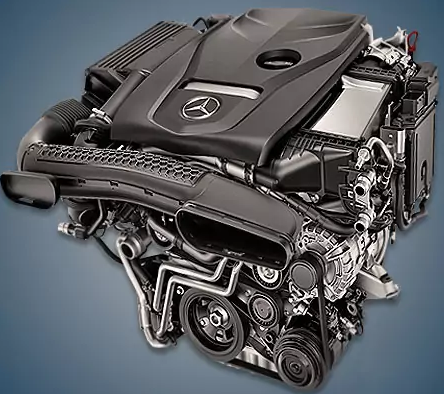
Since 2011, the company has been manufacturing 1.6 and 2.0-liter Mercedes M274 gasoline engines, which are installed on vehicles with longitudinal engines, like the C-class and E-class. The M270 index is used for similar motors in models where the unit is arranged transversely.
M102, M111, M133, M139, M166, M200, M254, M260, M264, M266, M270, M271, M274, and M282 are the R4 Mercedes engines.
A new line of 1.6 and 2.0 liter petrol engines made its debut in November 2011. An aluminum 16-valve cylinder head with hydraulic compensators, intake and exhaust dephasers, and an IHI AL0070 or IHI AL0071 turbine (depending on the engine version) with an air intercooler, direct injection system, oil pump variable capacity, and timing chain drive, as well as an aluminum block for four cylinders with cast-iron liners and an open cooling jacket. A Lanchester balancer is used to lessen vibration in the 2.0-liter engines.
Beginning in 2018, the engines of the M264 line gradually replaced the units of this series, which are now only manufactured as part of the hybrid power plant of the GLE or E-Class models.
Specifications
| Production years | since 2011 |
| Displacement, cc | 1595 (M 274 DE 16 AL) 1991 (M 274 DE 20 AL) |
| Fuel system | direct injection |
| Power output, hp | 129 – 156 (M 274 DE 16 AL) 156 – 245 (M 274 DE 20 AL) 279 – 333 together with electric motor |
| Torque output, Nm | 210 – 250 (M 274 DE 16 AL) 270 – 370 (M 274 DE 20 AL) 600 – 700 together with electric motor |
| Cylinder block | aluminum R4 |
| Block head | aluminum 16v |
| Cylinder bore, mm | 83 |
| Piston stroke, mm | 73.7 (M 274 DE 16 AL) 92 (M 274 DE 20 AL) |
| Compression ratio | 10.3 (M 274 DE 16 AL) 9.8 (M 274 DE 20 AL) |
| Hydraulic lifters | yes |
| Timing drive | chain |
| Phase regulator | yes |
| Turbocharging | yes |
| Recommended engine oil | 5W-30, 5W-40 |
| Engine oil capacity, liter | 6.0 – 7.0 |
| Fuel type | petrol |
| Euro standards | EURO 5/6 |
| Fuel consumption, L/100 km (for Mercedes C 250 2017) — city — highway — combined |
7.9 5.2 6.2 |
| Engine lifespan, km | ~300 000 |
| Weight, kg | 137 |
The engine was installed on:
- Mercedes C-Class W204 in 2012 – 2015; C-Class W205 in 2014 – 2020;
- Mercedes E-Class W212 in 2013 – 2016; E-Class W213 since 2016;
- Mercedes GLC-Class X253 since 2015;
- Mercedes GLE-Class W167 since 2019;
- Mercedes GLK-Class X204 in 2013 – 2015;
- Mercedes SLC-Class R172in 2015 – 2020;
- Mercedes V-Class W447 in 2015 – 2019;
- Infiniti Q50 1 (V37) in 2014 – 2019;
- Infiniti Q60 2 (CV37) in 2016 – 2018.
Disadvantages of the Mercedes M274 engine
Phase regulators in engines started to crack rather quickly until 2014. After the manufacturer finalized the design, the resource increased to 150–200 thousand kilometers. The timing chain is removed at roughly the same run, and numerous people swap them out simultaneously.
The displacement of the impulse disk with respect to the camshaft axis is the primary cause of the starting issues that many owners of vehicles with this family of engines complain about. An error on the camshaft position sensor typically indicates this.
The engines in this series were improved and made slightly more efficient in 2015, but this resulted in more frequent explosions that destroyed the pistons. Here, poor fuel quality also affects piezo direct injection injectors.
The power unit’s cooling system needs to be closely monitored because the head of the block can overheat even for brief periods of time. The water pump and thermostat’s relatively low dependability makes the issue worse.
Leaks frequently happen through the heat exchanger gasket, under the front crankshaft oil seal, or under the valve cover as a result of a stuck crankcase ventilation valve. The variable displacement oil pump valve freezes, the adsorber rapidly clogs, fuel hoses frequently leak, and the actuator at the turbine wedges as a result of wiring breaks.