
The well-known M273 engine found under the hood of the well-liked E, S, and GL class models was replaced in 2010 by the 4.6-liter V8 twin-turbocharged Mercedes M278. The power unit is available in various forcing levels but only one volume.
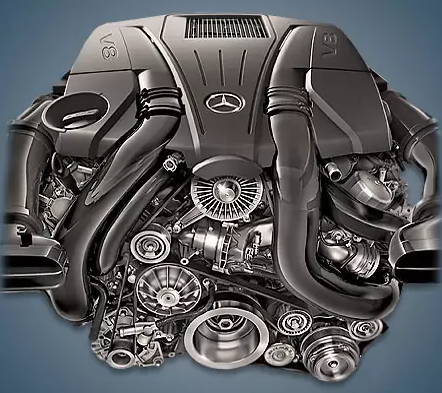
M113 E43, M113 E50, M113 E55, M119 E42, M119 E50, M119 E60, M156, M157, M177, M273, and M278 are all members of the V8-family.
Specifications
| Production years | since 2010 |
| Displacement, cc | 4663 |
| Fuel system | direct injection CGI |
| Power output, hp | 367 – 408 (M 278 DE 46 AL red.) 435 – 455 (M 278 DE 46 AL) |
| Torque output, Nm | 550 – 600 (M 278 DE 46 AL red.) 700 (M 278 DE 46 AL) |
| Cylinder block | aluminum V8 |
| Block head | aluminum 32v |
| Cylinder bore, mm | 92.9 |
| Piston stroke, mm | 86 |
| Compression ratio | 10.5 |
| Features | Bi-Turbo |
| Hydraulic lifters | yes |
| Timing drive | chain |
| Phase regulator | yes |
| Turbocharging | two Garrett MGT1752SM |
| Recommended engine oil | 0W-40 |
| Engine oil capacity, liter | 8.5 |
| Fuel type | petrol |
| Euro standards | EURO 5/6 |
| Fuel consumption, L/100 km (for Mercedes CLS 500 2012) — city — highway — combined |
12.5 6.9 9.0 |
| Engine lifespan, km | ~300 000 |
| Weight, kg | 220 |
The engine was installed on:
- Mercedes CL-Class C216 in 2010 – 2014; CL-Class C217 in 2014 – 2017;
- Mercedes CLS-Class W218 in 2011 – 2018;
- Mercedes E-Class W212 in 2011 – 2016;
- Mercedes GL-Class X166 in 2012 – 2015;
- Mercedes GLE-Class W166 in 2015 – 2018;
- Mercedes GLS-Class X166 in 2015 – 2019;
- Mercedes ML-Class W166 in 2012 – 2015;
- Mercedes S-Class W221 in 2011 – 2013; S-Class W222 in 2013 – 2017;
- Mercedes SL-Class R231 in 2012 – 2020.
Disadvantages of the M278 DE46 engine
The timing chain tensioners break easily because of the motor’s design.
You will need to replace the entire timing system with phase regulators if you ignore knocks.
Because of its poor dependability, the oil pump needs to be overhauled and scuffed.
The engine is vulnerable to detonation because the Alusil coating on the cylinder walls cannot withstand it.
Piezoceramic nozzles seldom last even 100,000 kilometers due to their fear of overheating.