
Produced between 2008 and 2012, the 1.6-liter turbocharged Mini John Cooper Works N14B16C was mounted in the rear of the R55, R56, or R57 models of the second generation Mini. Under its EP6DTS index, Peugeot and Citroen vehicles were equipped with the same power unit.
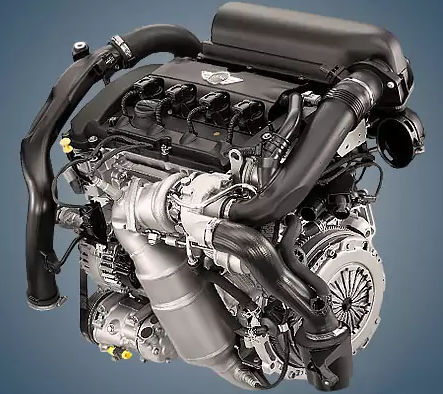
N12B14A, N12B16A, N16B16A, N14B16A, N14B16C, N18B16A, and N18B16C are engines from the Prince series.
Specifications
| Production years | 2008-2012 |
| Displacement, cc | 1598 |
| Fuel system | direct injection |
| Power output, hp | 211 |
| Torque output, Nm | 260 |
| Cylinder block | aluminum R4 |
| Block head | aluminum 16v |
| Cylinder bore, mm | 77 |
| Piston stroke, mm | 85.8 |
| Compression ratio | 10.0 |
| Features | DOHC |
| Hydraulic lifters | yes |
| Timing drive | chain |
| Phase regulator | at the exhaust |
| Turbocharging | BorgWarner K03 |
| Recommended engine oil | 5W-30 |
| Engine oil capacity, liter | 4.2 |
| Fuel type | petrol |
| Euro standards | EURO 4 |
| Fuel consumption, L/100 km (for Mini John Cooper Works 2009) — city — highway — combined |
9.4 5.8 7.1 |
| Engine lifespan, km | ~180 000 |
The engine was installed on:
- Mini Cabrio R57 in 2009 – 2012;
- Mini Clubman R55 in 2008 – 2012;
- Mini Hatch R56 in 2008 – 2012.
Disadvantages of the Mini N14B16C engine
Overheating is the motor’s primary issue, and cylinder head cracks are frequently seen here;
Large oil consumption follows, which causes coking in the intake;
Less than 50,000 kilometers are frequently covered by an unreliable timing chain, particularly its tensioner;
A small resource includes a high-pressure fuel pump for the injection system, a vacuum pump, and a phase regulator;
A thermostat and a water pump are also weak points of this power unit.