
The first generation of Mini R50 vehicles, including the R52 convertible, were equipped with the 1.6-liter gasoline engine Mini W10B16A, which the company produced between 2001 and 2008. Certain Chrysler models had a comparable power unit installed under its EJD index.
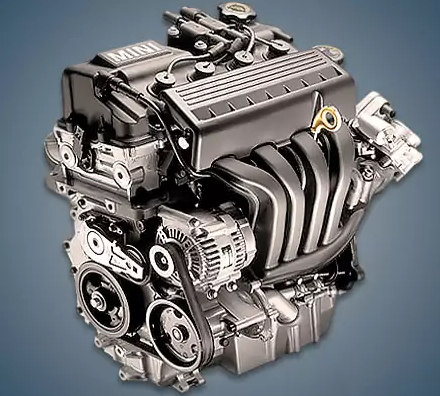
Engines from the Tritec series: W10B14A, W10B16A, and W11B16A.
Specifications
| Production years | 2001-2008 |
| Displacement, cc | 1598 |
| Fuel system | distributed injection |
| Power output, hp | 90 (One) 116 (Cooper) |
| Torque output, Nm | 140 (One) 150 (Cooper) |
| Cylinder block | cast iron R4 |
| Block head | aluminum 16v |
| Cylinder bore, mm | 77 |
| Piston stroke, mm | 85.8 |
| Compression ratio | 10.5 |
| Features | SOHC |
| Hydraulic lifters | yes |
| Timing drive | chain |
| Phase regulator | no |
| Turbocharging | no |
| Recommended engine oil | 5W-30 |
| Engine oil capacity, liter | 4.5 |
| Fuel type | petrol |
| Euro standards | EURO 4 |
| Fuel consumption, L/100 km (for Mini Cooper 2004) — city — highway — combined |
9.8 5.4 7.0 |
| Engine lifespan, km | ~300 000 |
The engine was installed on:
- Mini Cabrio R52 in 2004 – 2008;
- Mini Hatch R50 in 2001 – 2006.
Disadvantages of the Mini W10B16A engine
Power units frequently suffered from subpar assembly in the early years of production;
Here, rocker roller destruction and cylinder head cracks are also frequently observed;
Frequent malfunctions in the electronic throttle assembly’s operation lead to numerous issues;
The timing chain typically stretches and needs to be replaced closer to 150–200 thousand kilometers;
The hydraulic booster, expansion tank, and fuel pump are the engine’s weak points.