
Since 2014, the company’s factories have assembled the 2.0-liter Mini JCW B48A20B turbo engine, which is fitted in a charged John Cooper Works version on numerous third-generation Mini models. This unit can be boosted using either the standard 231 horsepower version or the 306 horsepower GP version.
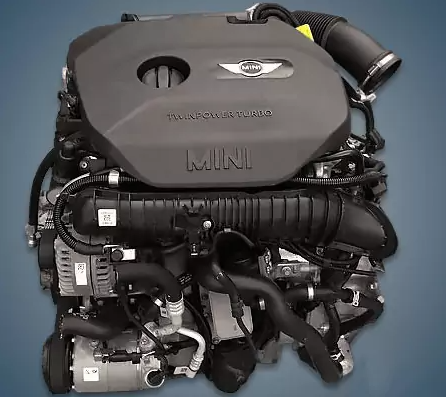
Engines from the B38/B48 series: B38A12A, B38A15A, B48A20A, and B48A20B.
Specifications
| Production years | since 2014 |
| Displacement, cc | 1998 |
| Fuel system | direct injection |
| Power output, hp | 231 306 (GP version) |
| Torque output, Nm | 320 – 350 450 (GP version) |
| Cylinder block | aluminum R4 |
| Block head | aluminum 16v |
| Cylinder bore, mm | 82 |
| Piston stroke, mm | 94.6 |
| Compression ratio | 10.2 9.5 (GP version) |
| Features | Valvetronic |
| Hydraulic lifters | yes |
| Timing drive | chain |
| Phase regulator | on both shafts |
| Turbocharging | MHI TD04LR6W |
| Recommended engine oil | 5W-30 |
| Engine oil capacity, liter | 5.0 |
| Fuel type | petrol |
| Euro standards | EURO 6 |
| Fuel consumption, L/100 km (for Mini John Cooper Works 2016) — city — highway — combined |
9.1 5.2 6.7 |
| Engine lifespan, km | ~230 000 |
The engine was installed on:
- Mini Cabrio 3 (F57) since 2016;
- Mini Clubman 2 (F54) since 2016;
- Mini Countryman 2 (F60) since 2017;
- Mini Hatch 3 (F56) since 2015.
Disadvantages of the Mini B48A20B engine
The timing belt’s design was updated in 2017, and the chain no longer stretches quickly;
Floating engine speeds are frequently caused by a tank vent valve malfunction;
Oil burns and tan valve stem seals are common near 100,000 kilometers; phase regulators or the Valvetronic system fail at high mileage.