
One of the most well-known four-cylinder in-line engines is the 4G63, which was created by Mitsubishi’s experts in Japan. This power unit has been installed on numerous Mitsubishi models with roughly a dozen different modifications.
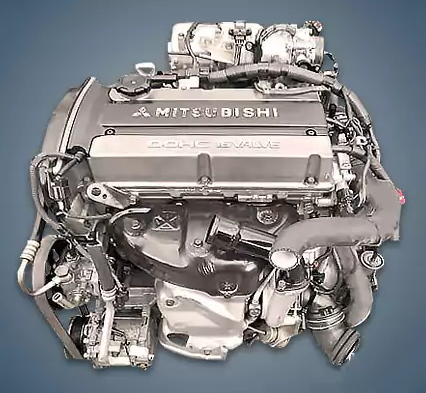
The original 4G63 was introduced in 1981 and is still manufactured today with a few minor modifications. This motor’s superior dependability is paired with its outstanding technical features. The engines can produce between 109 and 144 horsepower and have a 2.0 liter capacity.
The engine is highly reliable due to its ancient design, which has been tested for decades. For optimal overheating resistance, the 4G63 features an aluminum head and a cast iron cylinder block.
The advice is straightforward: use premium engine oil and replace it on schedule. Keep an eye out for oil leaks and replace drive belts as soon as possible. Other flaws are less common and don’t seriously harm the engine or the owner’s finances.
The engines 4G61, 4G62, 4G63T, 4G64, 4G67, and 4G69 are also part of the 4G6 family.
The engine was mounted on:
- Mitsubishi Delica III in 1989 – 1999;
- Mitsubishi Eclipse 1G in 1990 – 1994; Eclipse 2G in 1994 – 1999;
- Mitsubishi Galant A160 in 1980 – 1987; Galant E10 in 1983 – 1989; Galant E30 in 1987 – 1993; Galant E50 in 1992 – 1998; Galant EA0 in 1996 – 2003;
- Mitsubishi L200 L020 in 1980 – 1986; L200 K30 in 1986 – 1996; L200 K70 in 1996 – 2006;
- Mitsubishi Lancer CS0 in 2000 – 2007;
- Mitsubishi Outlander CU0 in 2001 – 2006;
- Mitsubishi Pajero L040 in 1982 – 1990;
- Mitsubishi Space Runner N10 in 1991 – 1997;
- Mitsubishi Space Wagon D00 in 1983 – 1991; Space Wagon N30 in 1991 – 1998; Space Wagon N50 in 1998 – 2004.
Specifications
| Production years | since 1981 |
| Displacement, cc | 1997 |
| Fuel system | carburetor / single injection (4G63 SOHC 8V) injector (4G633 SOHC 8V) injector (4G631, 4G632, 4G636 SOHC 16V) injector (4G635, 4G637 DOHC 16V) |
| Power output, hp | 87 – 110 (4G63 SOHC 8V) 109 (4G633 SOHC 8V) 133 – 137 (4G631, 4G632, 4G636 SOHC 16V) 135 – 144 (4G635, 4G637 DOHC 16V) |
| Torque output, Nm | 157 – 164 (4G63 SOHC 8V) 159 (4G633 SOHC 8V) 176 (4G631, 4G632, 4G636 SOHC 16V) 170 – 176 (4G635, 4G637 DOHC 16V) |
| Cylinder block | cast iron R4 |
| Block head | aluminum 16v |
| Cylinder bore, mm | 85 |
| Piston stroke, mm | 88 |
| Compression ratio | 8.6 – 9.0 (4G63 SOHC 8V) 9.0 (4G633 SOHC 8V) 10.0 (4G631, 4G632, 4G636 SOHC 16V) 9.8 – 10.5 (4G635, 4G637 DOHC 16V) |
| Features | no |
| Hydraulic lifters | yes |
| Timing drive | belt |
| Phase regulator | no |
| Turbocharging | no (except for 4G63T, for which a separate article) |
| Recommended engine oil | 5W-30 |
| Engine oil capacity, liter | 4.0 |
| Fuel type | petrol |
| Euro standards | EURO 1 (4G63 SOHC 8V) EURO 2 (4G633 SOHC 8V) EURO 2/3 (4G631, 4G632, 4G636 SOHC 16V) EURO 3/4 (4G635, 4G637 DOHC 16V) |
| Fuel consumption, L/100 km (for Mitsubishi Galant 1995) — city — highway — combined |
10.6 6.3 8.1 |
| Engine lifespan, km | ~400 000 |
| Weight, kg | 160 |
Disadvantages of the Mitsubishi 4G63 engine
The majority of this motor’s issues are caused by using inferior oil;
This first manifests as the balancer shafts jamming and the belt breaking;
The balance shafts in front of the wedge vibrate, destroying the power unit’s supports; a broken balancer belt frequently falls beneath the timing belt and the engine ends;
The lifespan of hydraulic lifters is greatly shortened by low-quality or outdated grease; another frequent issue is floating speed brought on by throttle and idle speed controller contamination;
Cracks in the intake-exhaust manifolds are a common source of complaints.