
From 1990 to 2002, the company assembled and installed the Mitsubishi 6G73 2.5-liter V6 gasoline engine on its models, as well as Dodge, Chrysler, and Hyundai under the G6AV index. There are three variations of this motor, one of which is GDi direct fuel injection.
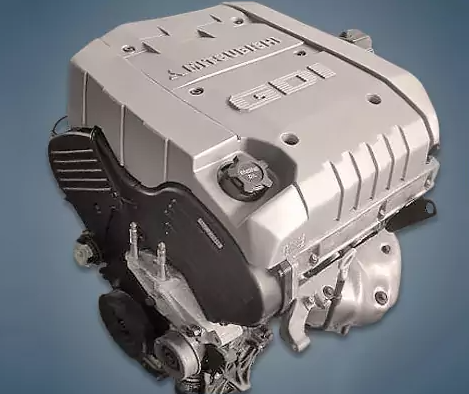
The power unit is dependable, resource-intensive, sufficiently powerful, and reasonably priced (average consumption is roughly 10 liters), just like other Cyclone family members.
The 6G7 family of gasoline V-shaped engines debuted a 2.5-liter engine in 1990. With a 60° camber angle, a cast-iron block, aluminum heads with hydraulic compensators, and a timing belt drive, it was the most popular V6 power unit at the time. All of these units had 24-valve cylinder heads, but they varied depending on the model: Mitsubishi vehicles had DOHC heads, while Dodge and Chrysler vehicles had SOHC heads.
Another iteration of the 6G73 engine debuted on the Diamante model’s second generation in 1995. This model had a compression ratio of 11 and a GDi direct fuel injection system.
The engines 6G71, 6G72, 6G72TT, 6G74, and 6G75 are also part of the 6G7 family.
The engine was mounted on:
- Mitsubishi Diamante 1 (F1) in 1990 – 1996;
- Mitsubishi Diamante 2 (F3) in 1995 – 2002;
- Mitsubishi Galant 7 (E5) in 1992 – 1996;
- Chrysler Cirrus 1 (JA) in 1995 – 2000;
- Chrysler Sebring 1 (JX) in 1995 – 2000;
- Dodge Avenger 1 Coupe (FJ) in 1994 – 2000;
- Dodge Stratus 1 (JX) in 1995 – 2000.
Specifications
| Production years | 1990-2002 |
| Displacement, cc | 2497 |
| Fuel system | distributed injection (MPI SOHC) distributed injection (MPI DOHC) direct injection (GDI DOHC) |
| Power output, hp | 165 – 170 (MPI SOHC) 170 – 175 (MPI DOHC) 200 (GDI DOHC) |
| Torque output, Nm | 220 – 230 (MPI SOHC) 220 – 230 (MPI DOHC) 250 (GDI DOHC) |
| Cylinder block | cast iron V6 |
| Block head | aluminum 24v |
| Cylinder bore, mm | 83.5 |
| Piston stroke, mm | 76 |
| Compression ratio | 9.4 (MPI SOHC) 10.0 (MPI DOHC) 11.0 (GDI DOHC) |
| Hydraulic lifters | yes |
| Timing drive | belt |
| Turbocharging | no |
| Recommended engine oil | 5W-30, 5W-40 |
| Engine oil capacity, liter | 5.0 |
| Fuel type | petrol |
| Euro standards | EURO 3 (MPI SOHC) EURO 3 (MPI DOHC) EURO 4 (GDI DOHC) |
| Fuel consumption, L/100 km (for Mitsubishi Diamante 2000) — city — highway — combined |
13.7 8.5 10.2 |
| Engine lifespan, km | ~400 000 |
| Weight, kg | 195 |
Disadvantages of the Mitsubishi 6G73 engine
Although many of these engines had an unpredictable GDi direct injection system, which can cause you a lot of issues, this distributed injection engine is not very picky about fuel quality. The high pressure fuel pump malfunctions particularly frequently.
Other than that, this motor is dependable, and the owners’ frequent complaints are limited to the oil burner. After 200,000 kilometers, the valve stem seals deteriorate or the rings collapse, leading to the appearance of lubricant consumption. The liners will turn if the oil level is neglected.
Even here, engine speed frequently floats for a variety of reasons, such as contaminated throttle, idle speed controller and injectors, damaged wiring, burned lambda probes, or a loosely installed manifold following candle replacement.
Breaks occur frequently even though the timing belt is thick and lasts far longer than the regulations. This occurs when the hydraulic tensioner’s oil channel cokes or when lubricant leaks from beneath the engine’s front cover, causing the oil to seep straight onto the belt.