
From 2007 to 2016, the company produced the Mitsubishi 4B11T 2.0-liter turbo engine, which was fitted to a number of Evolution X modifications and charged models like the Lancer Ralliart. This power unit comes in nine different versions with different levels of forcing.
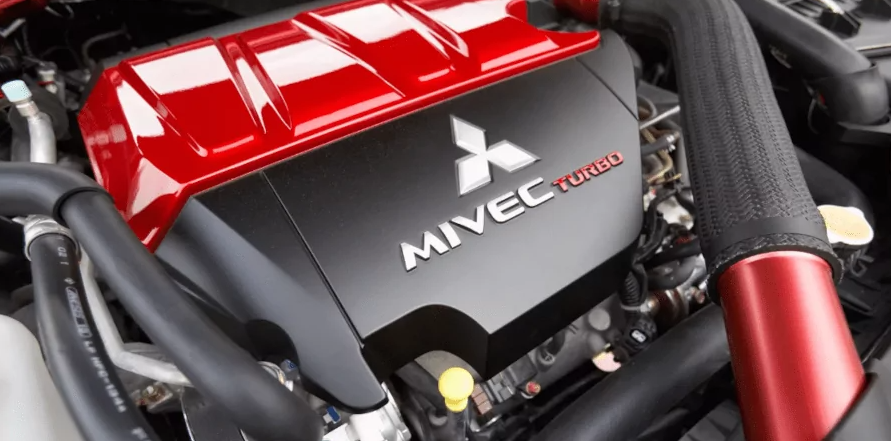
Instead of the cast iron cylinder block used in the previous 4G63T engine, the 4B11T is the first Lancer Evolution engine to use a cast aluminum cylinder block. Even with the addition of a timing chain in place of a belt, the engine’s weight has decreased by 12 kg from its predecessor.
Distributed fuel injection, an aluminum block with cast-iron sleeves, a 16-valve DOHC cylinder head without hydraulic lifters, a timing chain drive, and a MIVEC variable valve timing system on two camshafts are the fundamental design elements shared by all units in this family. However, the presence of oil nozzles, a semi-closed block rather than an open cooling jacket, and strengthened crankshaft bearing cap fastening are what set the supercharged engine apart. An MHI TD04HL or TD05H turbine, depending on the version, is, of course, installed in these units.
The cylinder head cover and timing chain housing are also made of aluminum. The 4B11T engine has a stainless steel outlet manifold at the back of the engine, an isometric short bore aluminum intake manifold, and an electronically controlled throttle.
The engines 4B10, 4B11, and 4B12 are also members of the 4B1 family.
The engine was mounted on:
- Mitsubishi Lancer 10 (CY) in 2007 – 2015;
- Mitsubishi Lancer Evolution X (CZ) in 2007 – 2016.
The Lancer Ralliart and Evolution X have nine distinct modifications installed in total:
- Mitsubishi Lancer Ralliart – 240 HP, 353 Nm
- Evolution X JDM Edition – 280 HP, 422 Nm
- Evolution X USA Edition – 295 HP, 407 Nm
- Evolution X EU Edition – 295 HP, 366 Nm
There were up to five versions of these turbo engines, which were highly popular in the UK:
- Evo X GB Edition FQ-300 – 300 HP, 409 Nm
- Evo X GB Edition FQ-330 – 329 HP, 437 Nm
- Evo X GB Edition FQ-360 – 359 HP, 492 Nm
- Evo X GB Edition FQ-400 – 409 HP, 525 Nm
- Evo X GB Edition FQ-440 – 446 HP, 559 Nm
Specifications
| Production years | 2007-2016 |
| Displacement, cc | 1998 |
| Fuel system | distributed injection |
| Power output, hp | 240 – 446 |
| Torque output, Nm | 340 – 560 |
| Cylinder block | aluminum R4 |
| Block head | aluminum 16v |
| Cylinder bore, mm | 86 |
| Piston stroke, mm | 86 |
| Compression ratio | 9.0 |
| Features | no |
| Hydraulic lifters | no |
| Timing drive | chain |
| Phase regulator | MIVEC |
| Turbocharging | MHI TD05H-152G6-12T MHI TD04HL-15T |
| Recommended engine oil | 5W-30, 5W-40 |
| Engine oil capacity, liter | 5.6 |
| Fuel type | petrol |
| Euro standards | EURO 4/5 |
| Fuel consumption, L/100 km (for Mitsubishi Lancer Evolution X 2010) — city — highway — combined |
13.6 8.3 10.2 |
| Engine lifespan, km | ~300 000 |
| Weight, kg | 134 |
Disadvantages of the Mitsubishi 4B11T engine
The most well-known issue with this engine is the piston rings that fall apart, causing the fragments to scratch the cylinder walls and occasionally even bend the candle electrodes. These ring particles are then released into the exhaust, where they frequently cause the turbine to stop working.
The chain functions flawlessly for 150 to 300 thousand kilometers on the atmospheric version of this unit, but in a turbo engine, its resources are limited, and replacement is frequently necessary after up to 50,000 kilometers. Phase regulators, which are highly costly here, also need to be replaced frequently.
Additionally, this motor cannot withstand overheating, so you must keep the oil coolers clean and replace the drive belt’s plastic rollers on a regular basis to prevent it from jumping off. The fuel pump and the frequently cracked exhaust manifold are weak points.