
From 2002 to 2021, the Kyoto plant produced the Mitsubishi 6G75 3.8-liter V6 engine, which was fitted to well-known models like the Endeavor, Pajero, Galant, and Eclipse.
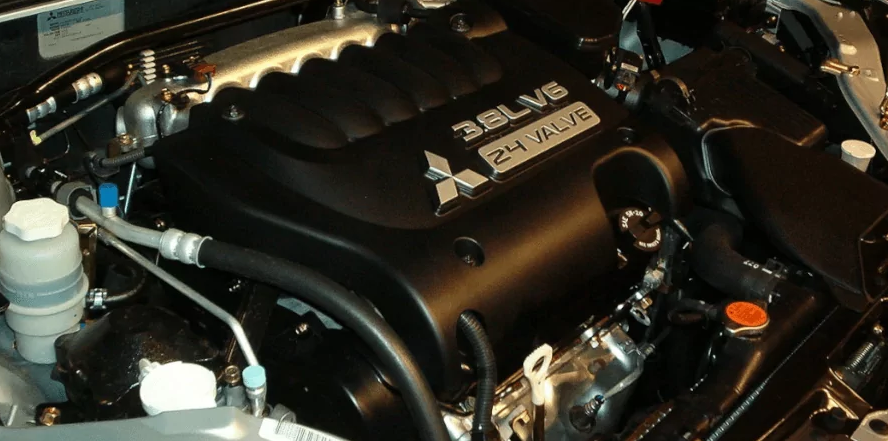
The most powerful engine in the Cyclone family made its debut on the redesigned Pajero 3 in 2002. With a cast-iron block, a 60° camber angle, distributed fuel injection, intake swirl flaps, and timing belt drive, it was an entirely typical V-shaped engine. Since it is the newest model in the series, it is much better than its predecessors (for instance, it has forged connecting rods). The unit’s 24 aluminum SOHC heads with hydraulic lifters were present in every version.
A more potent version of the engine with the exclusive MIVEC phase control system debuted in 2005, and the company sold both versions of this power unit concurrently for a considerable amount of time. A rare version of this engine with GDi direct fuel injection was available in the Japanese market.
The engines 6G71, 6G72, 6G72TT, 6G73, and 6G74 are also part of the 6G7 family.
The engine was mounted on:
- Mitsubishi Eclipse 4 (DK) in 2005 – 2011;
- Mitsubishi Endeavor 1 (D7) in 2003 – 2011;
- Mitsubishi Galant 9 (DJ) in 2003 – 2009;
- Mitsubishi Pajero 3 (V70) in 2002 – 2006;
- Mitsubishi Pajero 4 (V90) in 2006 – 2021.
Specifications
| Production years | 2002-2021 |
| Displacement, cc | 3828 |
| Fuel system | distributed injection (6G75 MPI) distributed injection (6G75 MPI MIVEC) direct injection (6G75 GDI) |
| Power output, hp | 215 – 230 (6G75 MPI) 245 – 265 (6G75 MPI MIVEC) 218 (6G75 GDI) |
| Torque output, Nm | 330 – 350 (6G75 MPI) 330 – 355 (6G75 MPI MIVEC) 339 (6G75 GDI) |
| Cylinder block | cast iron V6 |
| Block head | aluminum 24v |
| Cylinder bore, mm | 95 |
| Piston stroke, mm | 90 |
| Compression ratio | 9.8 (6G75 MPI) 10 – 10.5 (6G75 MPI MIVEC) 10 (6G75 GDI) |
| Hydraulic lifters | yes |
| Timing drive | belt |
| Turbocharging | no |
| Recommended engine oil | 5W-30, 5W-40 |
| Engine oil capacity, liter | 5.7 |
| Fuel type | petrol |
| Euro standards | EURO 3/4 (6G75 MPI) EURO 4/5 (6G75 MPI MIVEC) EURO 5 (6G75 GDI) |
| Fuel consumption, L/100 km (for Mitsubishi Pajero 2007) — city — highway — combined |
17.7 11.2 13.5 |
| Engine lifespan, km | ~400 000 |
| Weight, kg | 205 |
Disadvantages of the Mitsubishi 6G75 engine
The intake manifold swirl flaps that come with almost every version of this engine have a tendency to wedge before falling off entirely and into the engine cylinders. This frequently results in costly repairs, so it is best to remove them.
Up until 2009, a decline in the oil pump’s or the pressure-reducing valve wedge’s performance could cause the liners in engines to turn up to 100,000 kilometers. Since the engine was upgraded, this issue hardly ever arises.
Regular oil and antifreeze leaks, short-lived hydraulic lifters that occasionally knock at a range of 100–150 thousand kilometers, and floating speed caused by throttle contamination or burned-out lambda probes are some of this power unit’s weak points.