
From 2007 to 2017, the company assembled the 1.8-liter Mitsubishi 4B10 gasoline engine, which was mounted on popular Japanese models like the Lancer, ASX, and a comparable RVR. As a member of the Global Engine Manufacturing Alliance, Hyundai and Chrysler collaborated to develop this motor.
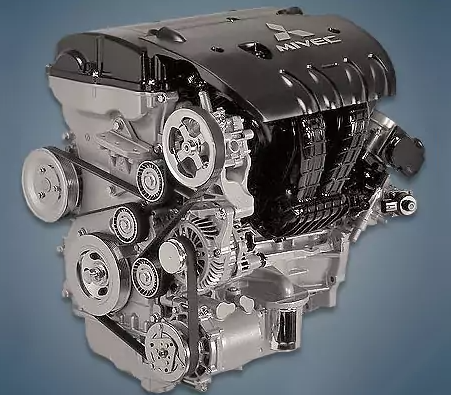
The Global Engine Manufacturing Alliance was established in 2002 by Hyundai, Mitsubishi, and Chrysler. As part of this alliance, a range of 1.8, 2.0, and 2.4 liter gasoline units was designed. Mitsubishi was the only one of the three companies to introduce a 1.8-liter engine into the lineup. With its distributed fuel injection, aluminum block with cast-iron sleeves, 16-valve head without hydraulic compensators, timing chain drive, and exclusive MIVEC type variable valve timing system, this engine is typical for its era. The next-generation gasoline unit with the 4J10 index was developed based on this engine.
The engines 4B11, 4B11T, and 4B12 are also part of the 4B1 family.
The engine was mounted on:
- Mitsubishi ASX 1 (GA) in 2010 – 2016;
- Mitsubishi Lancer 10 (CY) in 2007 – 2017.
Specifications
| Production years | 2007-2017 |
| Displacement, cc | 1798 |
| Fuel system | distributed injection |
| Power output, hp | 140 – 143 |
| Torque output, Nm | 172 – 178 |
| Cylinder block | aluminum R4 |
| Block head | aluminum 16v |
| Cylinder bore, mm | 86 |
| Piston stroke, mm | 77.4 |
| Compression ratio | 10.5 |
| Features | no |
| Hydraulic lifters | no |
| Timing drive | chain |
| Phase regulator | MIVEC |
| Turbocharging | no |
| Recommended engine oil | 5W-30, 5W-40 |
| Engine oil capacity, liter | 5.0 |
| Fuel type | petrol |
| Euro standards | EURO 4/5 |
| Fuel consumption, L/100 km (for Mitsubishi Lancer 2008) — city — highway — combined |
10.4 6.1 7.7 |
| Engine lifespan, km | ~350 000 |
| Weight, kg | 122 |
Disadvantages of the Mitsubishi 4B10 engine
This is a very dependable unit with no weak points, but at high mileage, rings or severe valve seat wear can cause it to consume oil. Additionally, an ellipse of cylinders and an open-jacketed block are not unusual in this engine.
The timing chain frequently stretches and begins to rattle during runs longer than 150–200 thousand kilometers. Only if you don’t experience significant wear on the phase regulators’ sprockets—which are rather costly—will the replacement itself and its replacement parts be reasonably priced.
The unit’s noisy operation, lubricant leaks, poor wiring, frequent exhaust pipe ring burnout, and simple exhaust manifold cracking are other issues raised by the owners. Additionally, since there are no hydraulic lifters here, remember to adjust the valve clearance.