
The company has only been producing the 2.4-liter Mitsubishi 4N15 diesel engine since 2015, and it is only found in the Pajero Sport SUV and the well-liked L200 pickup truck. An aluminum cylinder block and a MIVEC phase regulator set this unit apart from its predecessors.
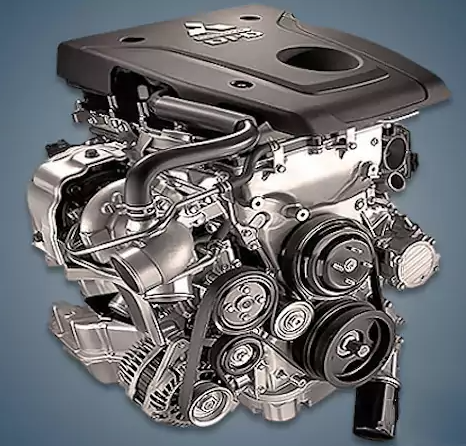
The engines 4N13 and 4N14 are also part of the 4N1 family.
The engine was mounted on:
- Mitsubishi L200 since 2015;
- Mitsubishi Pajero Sport since 2015.
Specifications
| Production years | since 2015 |
| Displacement, cc | 2442 |
| Fuel system | Common Rail |
| Power output, hp | 154 – 181 |
| Torque output, Nm | 380 – 430 |
| Cylinder block | aluminum R4 |
| Block head | aluminum 16v |
| Cylinder bore, mm | 86 |
| Piston stroke, mm | 105.1 |
| Compression ratio | 15.5 |
| Features | intercooler |
| Hydraulic lifters | no |
| Timing drive | chain |
| Phase regulator | MIVEC |
| Turbocharging | VGT |
| Recommended engine oil | 5W-30 |
| Engine oil capacity, liter | 8.4 |
| Fuel type | diesel |
| Euro standards | EURO 5 |
| Fuel consumption, L/100 km (for Mitsubishi L200 2016) — city — highway — combined |
8.7 6.2 7.1 |
| Engine lifespan, km | ~300 000 |
| Weight, kg | 163 |
Disadvantages of the Mitsubishi 4N15 engine
The EGR valve and a rapidly clogged particulate filter are the primary causes of the issues;
Expensive piezo injectors have been known to fail up to 100,000 kilometers;
The timing chain needed to be replaced for some owners whose mileage exceeded 100,000 kilometers;
The control unit is producing errors and the intake manifold flaps are covered in soot.