
The popular Cefiro, Cedric, or Leopard models on the Japanese market were initially powered by the 2.5-liter Nissan VQ25DE engine (abbreviated VQ25) in 1994. The Fuga, Teana sedans, and Elgrand minivan started to come equipped with a slightly modified motor in 2004. Under the V4U index, it was installed on Samsung and Renault vehicles.
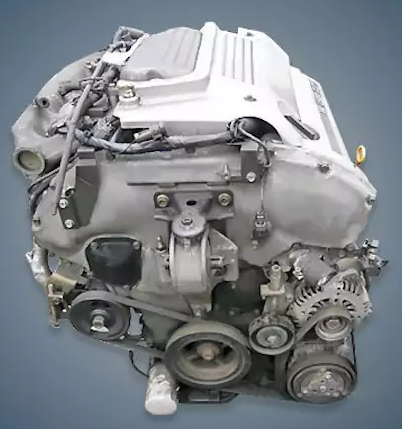
The VQ20 series includes VQ20DE, VQ23DE, VQ25DE, VQ25DET, VQ25DD, and VQ25HR.
Specifications
| Start of production | 1994 |
| Displacement, cc | 2495 |
| Fuel system | distributed injection |
| Power output, hp | 190 (1994 version) 185 – 210 (2004 version) |
| Torque output, Nm | 235 (1994 version) 230 – 265 (2004 version) |
| Cylinder block | aluminum V6 |
| Block head | aluminum 24v |
| Cylinder bore, mm | 85 |
| Piston stroke, mm | 73.3 |
| Compression ratio | 9.8 (1994 version) 9.8 – 10.3 (2004 version) |
| Features | ECCS, NDIS |
| Hydraulic lifters | no |
| Timing drive | three chains |
| Phase regulator | no (1994 version) CVTC at the intake (2004 version) |
| Turbocharging | no |
| Recommended engine oil | 5W-30 |
| Engine oil capacity, liter | 4.0 |
| Fuel type | petrol |
| Euro standards | EURO 3/4 (1994 version) EURO 4/5 (2004 version) |
| Fuel consumption, L/100 km (for Nissan Cefiro 2002) — city — highway — combined |
14.4 7.7 10.1 |
| Engine lifespan, km | ~330 000 |
| Weight, kg | 185 |
The engine was installed on:
- Nissan Cefiro 2 (A32) in 1994 – 2000; Cefiro 3 (A33) in 1998 – 2004;
- Nissan Cedric 9 (Y33) in 1995 – 1999;
- Nissan Elgrand 2 (E51) in 2002 – 2010;
- Nissan Fuga 1 (Y50) in 2004 – 2007;
- Nissan Gloria 10 (Y33) in 1995 – 1999;
- Nissan Leopard 4 (Y33) in 1996 – 1999;
- Nissan Teana 2 (J32) in 2008 – 2013;
- Renault Latitude 1 (L70) in 2010 – 2015;
- Samsung SM5 1 (A32) in 1998 – 2005; SM5 3 (L43) in 2009 – 2019;
- Samsung SM7 2 (L47) in 2011 – 2019.
Disadvantages of the VQ25DE engine
Catalyst crumbs entering the combustion chamber are the primary cause of the issues;
An oil burner with more than one liter per 1000 kilometers suggests that the cylinders may have a scuff;
The engine fears overheating, which causes mating surfaces to quickly warp;
A dirty idle valve is frequently the cause of floating speeds; oil seeps from beneath the valve cover and from the camshaft position sensors here. After 200,000 kilometers of operation, it frequently stretches here and the timing chain starts to rattle.