
Only the second generation BRZ sports coupe and the comparable Toyota GR86 are equipped with the 2.4-liter Subaru FA24D engine, which has been manufactured at the group’s Japanese facility since 2021. A D-4S combined injection system sets this naturally aspirated power unit apart.
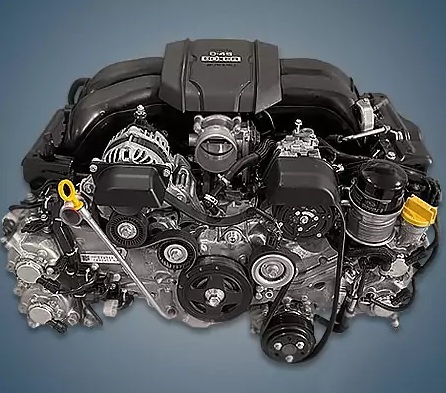
FA20, FA24F, and FA24D are members of the FA family.
Specifications
| Start of production | 2021 |
| Displacement, cc | 2387 |
| Fuel system | combined injection |
| Power output, hp | 230 – 235 |
| Torque output, Nm | 250 |
| Cylinder block | aluminum H4 |
| Block head | aluminum 16v |
| Cylinder bore, mm | 94 |
| Piston stroke, mm | 86 |
| Compression ratio | 12.5 |
| Features | DOHC |
| Hydraulic lifters | no |
| Timing drive | chain |
| Phase regulator | Dual AVCS |
| Turbocharging | no |
| Recommended engine oil | 0W-20 |
| Engine oil capacity, liter | 5.0 |
| Fuel type | petrol |
| Euro standards | EURO 6 |
| Fuel consumption, L/100 km (for Subaru BRZ 2022) — city — highway — combined |
12.5 6.9 8.3 |
| Engine lifespan, km | ~200 000 |
| Weight, kg | 165 |
The engine was installed on:
- Subaru BRZ 2 (ZD) since 2021;
- Toyota GT86 2 (ZN8) since 2021.
Disadvantages of the FA24D engine
Failures brought on by oil starvation are this unit’s most well-known issue.
However, it is important to note that every instance of wedge and liner rotation took place on the track.
The first theory is that the designers’ miscalculation caused the oil pressure to drop when cornering.
However, some owners discovered sealant in the oil intake when they opened the engine.
Additionally, there is a costly process for modifying valve clearances every 100,000 kilometers.