
From 2013 to 2018, a number of the German company’s charged models, including the Golf GTI and Octavia RS, were equipped with the 2.0-liter turbocharged VW CHHA or Golf 7 GTI 2.0 TSI. A different version of this motor with the CHHC index was available for the all-wheel drive Audi TT.
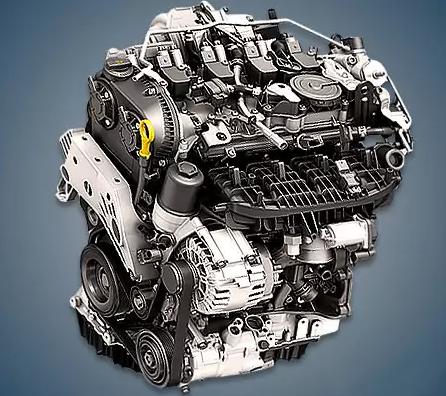
CJSA, CJSB, CJEB, CHHA, CHHB, CXDA, CNCD, and CJXC are all part of the EA888 gen3 series.
Specifications
| Production years | 2013-2018 |
| Displacement, cc | 1984 |
| Fuel system | FSI + MPI |
| Power output, hp | 230 |
| Torque output, Nm | 350 |
| Cylinder block | cast iron R4 |
| Block head | aluminum 16v |
| Cylinder bore, mm | 82.5 |
| Piston stroke, mm | 92.8 |
| Compression ratio | 9.6 |
| Features | AVS on the exhaust |
| Hydraulic lifters | yes |
| Timing drive | chain |
| Phase regulator | on both shafts |
| Turbocharging | IHI IS20 |
| Recommended engine oil | 0W-20 |
| Engine oil capacity, liter | 5.7 |
| Fuel type | petrol |
| Euro standards | EURO 6 |
| Fuel consumption, L/100 km (for VW Golf 7 GTI 2017) — city — highway — combined |
8.1 5.3 6.4 |
| Engine lifespan, km | ~230 000 |
| Weight, kg | 140 |
The engine was installed on:
- Skoda Octavia 3 (5E) in 2015 – 2018;
- Volkswagen Golf 7 (5G) in 2013 – 2018.
Disadvantages of the VW CHHA engine
The adjustable oil pump’s malfunctions are linked to the motor’s primary issues;
The engine’s liners may rotate as a result of a significant drop in lubricant pressure;
The timing chain and occasionally the phase shifters need to be replaced after 100,000 kilometers;
Every 50,000 kilometers, the boost pressure regulator V465 must be modified;
High temperatures frequently cause the water pump’s plastic housing to crack and leak.