
The seventh Golf and vehicles on its platform, including the Octavia A7 and Seat Leon 3, were equipped with the 1.4-liter Volkswagen CHPA 1.4 TSI gasoline engine, which was manufactured between 2012 and 2015. The ACT system was installed in this power unit under a different CPTA index.
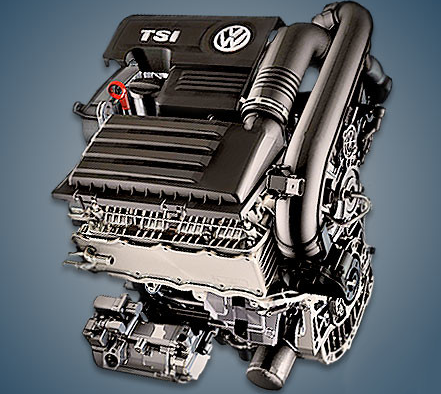
CWVA, CWVB, CJZA, CJZB, CHPA, CMBA, CXSA, CZCA, CZDA, CZEA, DJKA, DACA, and DADA are all part of the EA211 series.
Specifications
| Production years | 2012-2015 |
| Displacement, cc | 1395 |
| Fuel system | direct injection |
| Power output, hp | 140 |
| Torque output, Nm | 250 |
| Cylinder block | aluminum R4 |
| Block head | aluminum 16v |
| Cylinder bore, mm | 74.5 |
| Piston stroke, mm | 80 |
| Compression ratio | 10.0 |
| Features | DOHC |
| Hydraulic lifters | yes |
| Timing drive | belt |
| Phase regulator | on both shafts |
| Turbocharging | IHI RHF3 |
| Recommended engine oil | 5W-30 |
| Engine oil capacity, liter | 3.8 |
| Fuel type | petrol |
| Euro standards | EURO 5 |
| Fuel consumption, L/100 km (for VW Golf 2013) — city — highway — combined |
6.1 4.4 5.0 |
| Engine lifespan, km | ~240 000 |
| Weight, kg | 106 |
The engine was installed on:
- Skoda Octavia 3 (5E) in 2012 – 2015;
- Seat Leon 3 (5F) in 2012 – 2014;
- Volkswagen Golf 7 (5G) in 2012 – 2014.
Disadvantages of the VW CHPA engine
First, there is the oil burner issue, particularly with engines prior to 2013;
Following this, the wastegate actuator’s thrust breaks down as a result of souring-jamming; additionally, inexperienced artisans frequently harm the ignition coils when changing candles;
An expensive pump with two thermostats frequently leaks after 100,000 kilometers;
A lengthy warm-up and unnecessary noise-knocks are linked to the remaining complaints.