
From 1991 to 1996, the company produced the 2.0-liter 8-valve Audi ABK engine, which was fitted to popular German models like the 80 B4, 100 C4, and A6 C4. An extremely dependable Digifant multipoint injection system was installed in this power unit.
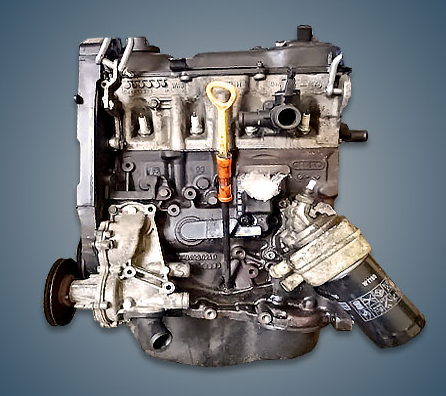
The EA827 2.0l series includes: 2E, AAD, AAE, ABT, ABK, ADY, AGG, ABF, ACE.
Specifications
| Production years | 1991-1996 |
| Displacement, cc | 1984 |
| Fuel system | Digifant |
| Power output, hp | 115 |
| Torque output, Nm | 168 |
| Cylinder block | cast iron R4 |
| Block head | aluminum 8v |
| Cylinder bore, mm | 82.5 |
| Piston stroke, mm | 92.8 |
| Compression ratio | 10.3 |
| Features | SOHC |
| Hydraulic lifters | yes |
| Timing drive | belt |
| Phase regulator | no |
| Turbocharging | no |
| Recommended engine oil | 5W-30 |
| Engine oil capacity, liter | 3.0 |
| Fuel type | petrol |
| Euro standards | EURO 2 |
| Fuel consumption, L/100 km (for Audi 80 1992) — city — highway — combined |
11.3 6.0 7.4 |
| Engine lifespan, km | ~350 000 |
The engine was installed on:
- Audi 80 B4 (8C) in 1991 – 1995;
- Audi 100 C4 (4A) in 1991 – 1994;
- Audi A6 C4 (4A) in 1994 – 1996.
Disadvantages of the Audi ABK engine
With its low failure rate, this motor is rightfully regarded as one of the most dependable in its class.
Unstable operation is typically caused by a dirty idle speed controller or malfunctioning sensors.
Additionally, a few ignition system parts frequently malfunction here.
The valves typically do not bend when the timing belt breaks, which occurs every 90,000 kilometers.
An oil burner and hydraulic lifter knocks are frequently discovered after 200,000 kilometers of operation.