
From 1990 to 1996, the German company’s factories assembled the 2.3-liter Audi AAR engine, which was fitted to the model under the index 100 in C3–C4 bodies and the original A6.
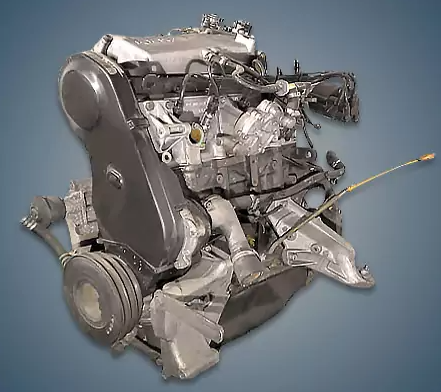
The EA828 series includes: RT, KU, NF, NG, AAR, AAN.
Specifications
| Production years | 1990-1996 |
| Displacement, cc | 2309 |
| Fuel system | KE-III-Jetronic |
| Power output, hp | 133 |
| Torque output, Nm | 186 |
| Cylinder block | cast iron R5 |
| Block head | aluminum 10v |
| Cylinder bore, mm | 82.5 |
| Piston stroke, mm | 86.4 |
| Compression ratio | 10.0 |
| Features | SOHC |
| Hydraulic lifters | yes |
| Timing drive | belt |
| Phase regulator | no |
| Turbocharging | no |
| Recommended engine oil | 5W-40 |
| Engine oil capacity, liter | 4.5 |
| Fuel type | petrol |
| Euro standards | EURO 2 |
| Fuel consumption, L/100 km (for Audi A6 1995) — city — highway — combined |
13.2 7.6 9.3 |
| Engine lifespan, km | ~350 000 |
The engine was installed on:
- Audi 100 C3 (44) in 1990 – 1991; 100 C4 (4A) in 1990 – 1994;
- Audi A6 C4 (4A) in 1994 – 1996.
Disadvantages of the Audi AAR engine
The KE-III-Jetronic injection system’s unpredictability is the primary cause of engine issues;
Unstable engine operation is typically caused by air leaks or idle valve contamination;
The nozzles clog rather quickly, and the fuel pump has a short lifespan;
Slider or distributor cover failures are common in ignition systems; high mileage causes hydraulic lifters to wear out and start knocking.