
From 2009 to 2014, the company produced the 2.5-liter Audi CEPA 2.5 TFSI turbo engine, which was mounted on a charged version of the TT RS model in the 8J body and the RS3 in the 8P body. A 360 horsepower version of this power unit is available under its CEPB index.
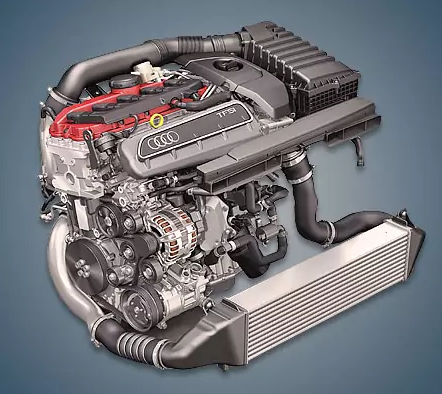
The EA855 series includes: BGP, CBTA, CEPA, CTSA, DAZA, DNWA.
Specifications
| Production years | 2009-2014 |
| Displacement, cc | 2480 |
| Fuel system | direct injection |
| Power output, hp | 340 |
| Torque output, Nm | 450 |
| Cylinder block | cast iron R5 |
| Block head | aluminum 20v |
| Cylinder bore, mm | 82.5 |
| Piston stroke, mm | 92.8 |
| Compression ratio | 10.0 |
| Features | intercooler |
| Hydraulic lifters | yes |
| Timing drive | chain |
| Phase regulator | on both shafts |
| Turbocharging | BorgWarner K16 |
| Recommended engine oil | 5W-30 |
| Engine oil capacity, liter | 6.5 |
| Fuel type | petrol |
| Euro standards | EURO 5 |
| Fuel consumption, L/100 km (for Audi RS3 2012) — city — highway — combined |
13.1 6.8 9.1 |
| Engine lifespan, km | ~220 000 |
The engine was installed on:
- Audi RS3 2 (8P) in 2011 – 2013;
- Audi TT 2 (8J) in 2009 – 2014.
Disadvantages of the Audi CEPA engine
The direct fuel injection system causes the intake valves to coke quickly; the timing chain has a modest resource here, often extending to 100,000 km;
The adsorber valve frequently fails, necessitating the replacement of the entire assembly; we recommend that you clean the crankcase ventilation on a regular basis to prevent clogging and leaks; additionally, oil frequently seeps from beneath the timing side cover and valve cover.