
Overview & Design Features
The GMC LB4 engine is a 4.3-liter (262 cubic inch) 90-degree V6 gasoline engine, a prominent member of General Motors’ Small-Block engine family. Introduced in 1985, the LB4 was a significant engine for GM, being one of the first production V6 engines to feature Throttle Body Injection (TBI) and serving as the foundational V6 architecture for numerous light trucks, SUVs, and vans throughout the late 1980s and early 1990s. Its design prioritized durability and cost-effectiveness, becoming a workhorse in various utility applications.
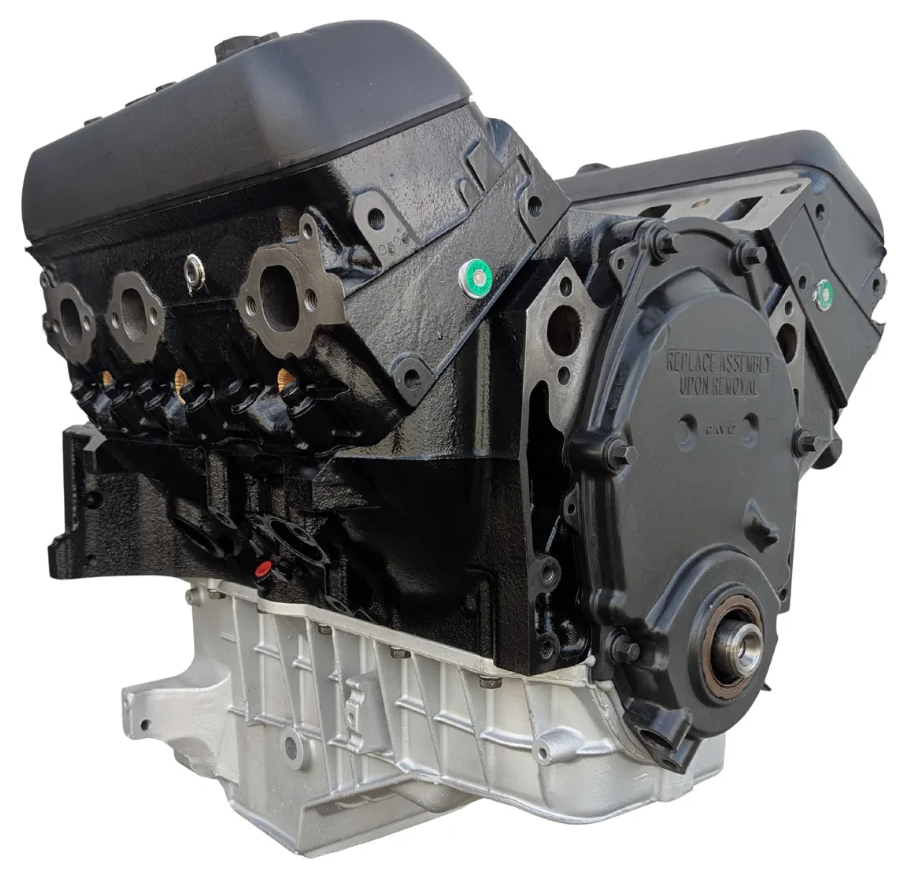
Engineered with a robust design, the LB4 utilizes a cast iron cylinder block and cast iron cylinder heads, ensuring long-term strength and heat dissipation. Its fuel delivery system consists of a single Throttle Body Injection (TBI) unit mounted centrally on the intake manifold, providing a simple and reliable electronic fuel injection solution for its era. The valvetrain employs a pushrod Overhead Valve (OHV) design, characteristic of the Small-Block family, actuated by a single camshaft located within the block. This two-valve-per-cylinder configuration, combined with a traditional distributor-based ignition system, emphasizes mechanical simplicity and proven reliability over advanced performance features like variable valve timing.
The LB4 engine was widely deployed across several General Motors’ light-duty truck and utility vehicle lines. Key models utilizing the LB4 include the Chevrolet S-10 and GMC S-15 Sonoma compact pickups, the Chevrolet Blazer and GMC Jimmy SUVs, and the Chevrolet Astro and GMC Safari full-size vans. It was also found in some full-size C/K series pickups, primarily as a base engine option. Production for the LB4 variant spanned from approximately 1985 through 1995, with numerous minor revisions over its lifespan, before being succeeded by Vortec versions of the 4.3L V6.
Technical Specifications
| Specification | Value |
|---|---|
| Displacement (cc) | 4300 |
| Max Power (hp (kW) @ RPM) | 160 (119) @ 4000 |
| Max Torque (Nm (kg*m) @ RPM) | 312 (31.8) @ 2800 |
| Fuel Type | Gasoline (Regular Unleaded) |
| Fuel Consumption (l/100 km) | Approx. 13-16 (Combined, vehicle dependent) |
| Engine Type | 90-degree V6, Naturally Aspirated |
| Compression Ratio | 9.3:1 |
| Cylinder Bore (mm) | 101.6 |
| Piston Stroke (mm) | 88.4 |
| Valvetrain | Pushrod Overhead Valve (OHV) |
| Valves per Cylinder | 2 |
| Additional Info | Throttle Body Injection (TBI), Distributor Ignition |
Common Problems & Reliability
The GMC LB4 engine is generally considered a highly reliable and durable powerplant, a testament to its simple, robust design. However, specific common issues can arise, particularly in high-mileage examples. A frequent point of concern involves the Throttle Body Injection (TBI) unit. Over time, the injectors within the TBI unit can become clogged or leak, leading to poor fuel atomization, reduced fuel economy, and rough idle. Additionally, wear in the throttle shaft bushings can create vacuum leaks, further impacting engine performance. Another common area of failure relates to the ignition system, specifically the distributor and its internal components, such as the ignition control module or pickup coil. These components can fail, causing misfires, stalling, or a no-start condition. Lastly, intake manifold gasket leaks are not uncommon. These can manifest as external oil or coolant leaks, or internal leaks leading to coolant consumption or oil contamination, particularly after many thermal cycles. Despite these potential issues, the engine’s cast iron construction ensures a strong foundation. With proper and consistent maintenance, an LB4 engine typically exhibits a service life of 200,000 to 250,000 miles (320,000-400,000 km) before requiring a major overhaul.
Maintenance Tips & Service Schedule
Maintaining the LB4 engine is straightforward, given its basic design. Adherence to a consistent service schedule is paramount for maximizing its longevity. Engine oil and filter changes should be performed every 3,000-5,000 miles (5,000-8,000 km) or every 6 months, using an oil viscosity of 5W-30 or 10W-30, depending on ambient temperatures and manufacturer recommendations. Spark plugs are typically recommended for replacement every 30,000-50,000 miles (48,000-80,000 km) to maintain optimal combustion efficiency. The LB4 employs a robust timing chain, which generally does not require periodic replacement like a timing belt; inspection for excessive slack or noise is advisable at higher mileages, typically beyond 100,000 miles (160,000 km). Coolant flushes should be performed every 2-3 years or 30,000-50,000 miles (48,000-80,000 km) to prevent corrosion and maintain cooling system efficiency. The fuel filter should be replaced every 15,000-30,000 miles (24,000-48,000 km) to protect the TBI unit. Finally, the air filter should be inspected regularly and replaced annually or every 12,000-15,000 miles (19,000-24,000 km).
Conclusion
The GMC LB4 engine, while lacking modern refinements, stands as a testament to durability and mechanical simplicity. For a used vehicle buyer prioritizing a proven, reliable, and easily repairable engine over cutting-edge performance or fuel economy, the LB4 represents a safe choice. Its robust cast iron construction, uncomplicated TBI fuel system, and pushrod valvetrain contribute to its legendary longevity. Potential buyers should, however, consider the age of any vehicle equipped with this engine and budget for common maintenance items such as TBI unit refurbishment or ignition system components. With consistent preventative maintenance, an LB4-equipped vehicle can continue to serve reliably for many years and miles.