
Since 2017, the 2.0-liter Land Rover PT204 gasoline engine has been manufactured at a facility in England and fitted to the majority of contemporary Discovery, Evoque, and Velar models. This unit has its own index, AJ200P, for vehicles made under the Jaguar brand.
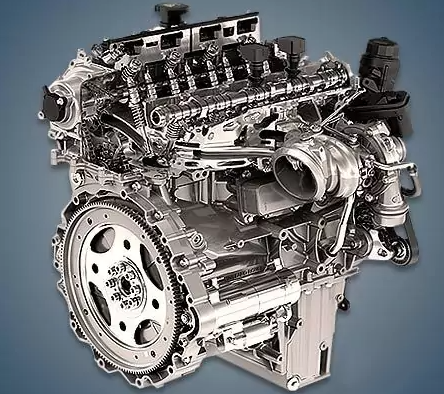
Engines from the Ingenium series: PT204, 204DTA, and 204DTD.
Specifications
| Production years | since 2017 |
| Displacement, cc | 1997 |
| Fuel system | direct injection |
| Power output, hp | 200 – 300 |
| Torque output, Nm | 320 – 400 |
| Cylinder block | aluminum R4 |
| Block head | aluminum 16v |
| Cylinder bore, mm | 83 |
| Piston stroke, mm | 92.29 |
| Compression ratio | 9.5 – 10.5 |
| Features | intercooler |
| Hydraulic lifters | yes |
| Timing drive | chain |
| Phase regulator | on both shafts |
| Turbocharging | twin-scroll |
| Recommended engine oil | 0W-20 |
| Engine oil capacity, liter | 7.0 |
| Fuel type | petrol |
| Euro standards | EURO 6 |
| Fuel consumption, L/100 km (for Range Rover Velar 2019) — city — highway — combined |
9.1 6.7 7.6 |
| Engine lifespan, km | ~240 000 |
| Weight, kg | 120 |
The engine was installed on:
- Land Rover Defender 2 (L663) since 2019;
- Land Rover Discovery 5 (L462) since 2017;
- Land Rover Discovery Sport 1 (L550) since 2017;
- Land Rover Range Rover Evoque 1 (L538) in 2017 – 2018; Evoque 2 (L551) since 2019;
- Land Rover Range Rover 4 (L405) since 2018;
- Land Rover Range Rover Sport 2 (L494) since 2018;
- Land Rover Range Rover Velar 1 (L560) since 2017.
Disadvantages of the Land Rover PT204 engine
The engine has already been plagued by numerous issues despite its brief production period;
The charge air pipe was frequently torn during the engine’s initial years of production; the oil pump became wedged here because the bolts used to secure the crankshaft pulley were too long;
The clutch of the phase regulator on the intake camshaft is another minor resource; the timing chain frequently needs to be replaced after 150,000 kilometers of operation.