
From 2001 to 2018, the company produced the 1.2-liter 16-valve Renault D4F engine, which was fitted on the Twingo, Clio, Symbol, Dacia Logan, and Sandero, among other compact models. This turbocharged power unit was modified to have a different D4Ft index.
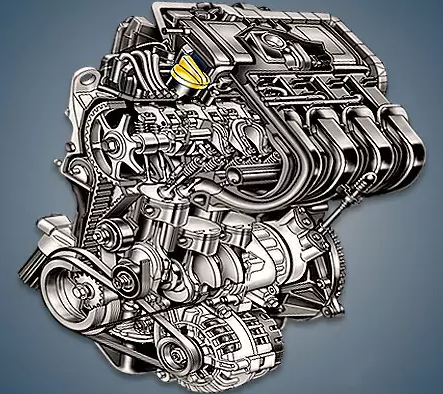
D4Ft and D7F are also part of the D-series.
A 1.2-liter D7F engine with 16 valves made its debut on the Twingo in 2001. This is the same four-cylinder cast-iron block with a timing belt drive, but it has a very unique cylinder head. Because of its small size, one camshaft opens all sixteen valves with bifurcated rockers. There are no hydraulic compensators; valve clearance must be adjusted on a regular basis.
There were two versions of the 700 series’ initial engines: 60 horsepower and 100 Nm and 75 horsepower and 105 Nm. Next came the 720 series, which had a bigger air filter and a different intake manifold. The 740 series engines received a camshaft with a different cam shape in 2005 with the introduction of the Clio 3. As a result, the younger engine’s power increased to 65 horsepower and 105 Nm, while the older engine’s power increased to 79 horsepower and 108 Nm.
The engine was mounted on:
- Dacia Logan 1 (L90) in 2009 – 2012; Logan 2 (L52) in 2012 – 2016;
- Dacia Sandero 1 (B90) in 2008 – 2012; Sandero 2 (B52) in 2012 – 2017;
- Proton Savvy 1 in 2005 – 2013;
- Renault Clio 2 (X65) in 2001 – 2005; Clio 3 (X85) in 2005 – 2013; Clio 4 (X98) in 2012 – 2018;
- Renault Kangoo 1 (KC) in 2001 – 2005;
- Renault Modus 1 (J77) in 2004 – 2012;
- Renault Grand Modus 1 (F77) in 2004 – 2012;
- Renault Sandero 2 (B52) in 2014 – 2016;
- Renault Symbol 1 (L65) in 2006 – 2008; Symbol 2 (L35) in 2008 – 2013; Symbol 3 (L52) in 2013 – 2017;
- Renault Twingo 1 (C06) in 2001 – 2007; Twingo 2 (C44) in 2007 – 2014.
Specifications
| Production years | 1992-2003 |
| Displacement, cc | 1149 |
| Fuel system | injector |
| Power output, hp | 73 – 79 60 – 65 (deforced ver.) |
| Torque output, Nm | 105 – 108 100 – 105 (deforced ver.) |
| Cylinder block | cast iron R4 |
| Block head | aluminum 16v |
| Cylinder bore, mm | 69 |
| Piston stroke, mm | 76.8 |
| Compression ratio | 9.8 |
| Hydraulic lifters | no |
| Timing drive | belt |
| Turbocharging | no |
| Recommended engine oil | 5W-30, 5W-40 |
| Engine oil capacity, liter | 4.8 |
| Fuel type | petrol |
| Euro standards | EURO 3/4 EURO 4/5 (deforced ver.) |
| Fuel consumption, L/100 km (for Renault Twingo 2010) — city — highway — combined |
6.7 4.2 5.1 |
| Engine lifespan, km | ~300 000 |
| Weight, kg | 88 |
Disadvantages of the Renault D4F engine
This type of power unit is well known for its erratic electrics and, most importantly, sensors. Additionally, an unreliable ignition coil with integrated high-voltage wires is present.
The timing belt is supposed to change every 120,000 kilometers, but if it breaks before then, the valves will still be bent. Checking its condition on a regular basis is therefore preferable.
Unadjusted valves are typically the cause of the motor’s noisy operation. When making adjustments, take off the intake manifold and valve cover and replace the gaskets.
Additionally, the owners of this motor frequently worry about insignificant issues, such as oil leaks, short attachment service life, and a gas pump that cannot handle subpar fuel.