
Since 2018, the company has been producing the 1.0-liter turbocharged Renault H4Dt or 1.0 TCe 100, which is installed on the fifth generation of the Clio model or the Captur crossover built around it. This power unit has the HR10DET index on vehicles made under the Nissan brand.
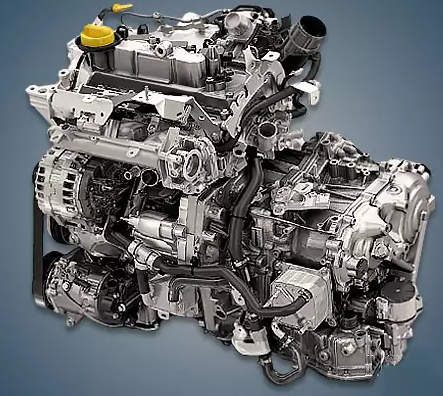
The engines in the TCe line are H4Bt, H4Dt, H5Dt, D4Ft, H5Ft, H5Ht, H4Jt, M5Mt, M5Pt, and F4Rt.
Specifications
| Production years | since 2018 |
| Displacement, cc | 999 |
| Fuel system | distributed injection |
| Power output, hp | 100 |
| Torque output, Nm | 160 |
| Cylinder block | aluminum R3 |
| Block head | aluminum 12v |
| Cylinder bore, mm | 72.2 |
| Piston stroke, mm | 81.3 |
| Compression ratio | 9.5 |
| Features | no |
| Hydraulic lifters | no |
| Timing drive | chain |
| Phase regulator | at the intake |
| Turbocharging | yes |
| Recommended engine oil | 5W-30 |
| Engine oil capacity, liter | 3.3 |
| Fuel type | petrol |
| Euro standards | EURO 6 |
| Fuel consumption, L/100 km (for Renault Clio 2020) — city — highway — combined |
5.4 3.8 4.6 |
| Engine lifespan, km | ~250 000 |
| Weight, kg | 87 |
The engine was installed on:
- Renault Clio 5 (BF) since 2019;
- Renault Captur 2 (JB) since 2020;
- Renault Kiger 1 (HBC) since 2021;
- Dacia Duster 2 (HM) since 2019;
- Dacia Jogger 1 (RJI) since 2021;
- Dacia Logan 2 (L52) in 2019 – 2020; Logan 3 (LJI) since 2020;
- Dacia Sandero 3 (BJI) since 2020.
Disadvantages of the Renault H4Dt engine
The first owners frequently complained about leaks from under the valve covers; the timing chain is a modest resource here, serving from 100 to 150 thousand kilometers; the phase regulator on the intake shaft may crackle approximately at the same run; many complaints about dips in traction occurred during the first year, but everything was fixed with the firmware;
The valve clearance needs to be changed every 60,000 kilometers because there are no hydraulic lifters.