
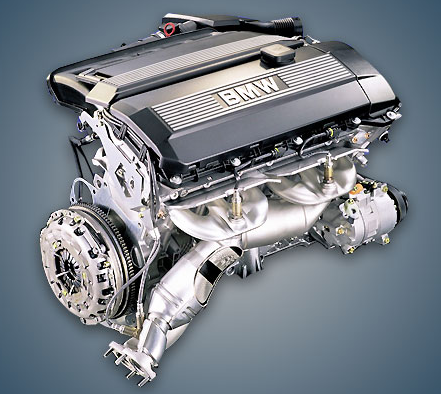
Introduced in 1995, the BMW M52B25 engine from the M52 family (which also included the M52B20, M52B24, M52B28, and S52B32) was intended to replace the 2.5-liter M50 representative. The bottom’s geometry stayed the same, but the pistons and connecting rods were modified, and the cast-iron block was swapped out for a lightweight aluminum cylinder coated with Nikasil.
M52B25 piston compression height: 32.55 mm; connecting rod length: 140 mm. An alternative intake system was used. All engines now use the variable valve timing system, and the cylinder head from the M50 Vanos has been moved. 190 cc injectors on the M52B25.
The motor was renamed M52TUB25 (Technical update) in 1998 after undergoing some changes. Cast-iron cylinder block liners, a second phase shifter on the exhaust shaft (Double-VANOS), additional camshafts (244/228 lift 9/9 mm), pistons and connecting rods, a new DISA intake manifold, a modified cooling system, and an electronic throttle are a few of the innovations.
This power unit was utilized on BMW vehicles with the 23i index since it proved to be less powerful and more torquey than the M50B25.
Specifications
| Production years | 1995-2001 Munich Plant |
| Displacement, cc | 2494 |
| Fuel system | injector |
| Power output, hp | 170 |
| Torque output, Nm | 245 |
| Cylinder block | aluminum R6 |
| Block head | aluminum 24v |
| Cylinder bore, mm | 84 |
| Piston stroke, mm | 75 |
| Compression ratio | 10.5 |
| Features | no |
| Hydraulic lifters | yes |
| Timing drive | chain |
| Phase regulator | single VANOS (M52B25) double VANOS (M52B25TU) |
| Turbocharging | no |
| Recommended engine oil | 5W-30 |
| Engine oil capacity, liter | 6.5 |
| Fuel type | petrol |
| Euro standards | EURO 2 (M52B25) EURO 3 (M52B25TU) |
| Fuel consumption, L/100 km (for E36 323i) — city — highway — combined |
13.0 6.7 9.0 |
| Engine lifespan, km | ~350 000 |
| Weight, kg | ~165 (M52B25) ~175 (M52B25TU) |
Disadvantages of the M52B25 engine
Cylinders coated with nikasil were used in the early years, but they soon collapsed;
The engine is so terrified of overheating that the cylinder head breaks through its gasket right away;
Coked hydraulic lifters are typically the source of frequent misfires;
The DISA variable geometry damper may come loose and tumble into cylinders;
The membrane of the crankcase ventilation valve is another weak point.
The Vanos phase control system frequently needs to be fixed after 100,000 kilometers of operation; an oil burn frequently starts after 200,000 kilometers because of stuck piston rings.