
From 1993 to 2008, the company’s plants in Japan and the USA produced the 3.0-liter Toyota 1MZ-FE engine, which was installed on a variety of Japanese concern models for all markets. The power unit is typically divided into two versions: one with and one without a VVT-i phase regulator at the intake.
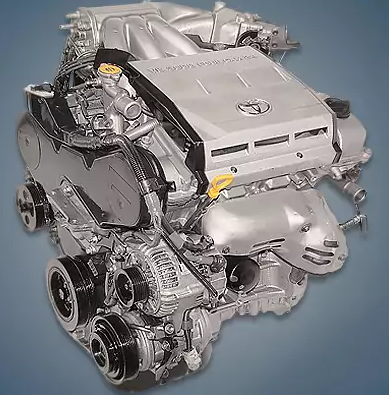
The engines 2MZ-FE and 3MZ-FE are also part of the MZ family.
The engine was mounted on:
- Toyota Alphard 1 (AH10) in 2002 – 2008;
- Toyota Avalon 1 (XX10) in 1994 -1999; Avalon 2 (XX20) in 1999 -2004;
- Toyota Camry 3 (XV10) in 1993 – 1996; Camry 4 (XV20) in 1996 – 2001; Camry 5 (XV30) in 2001 – 2006;
- Toyota Estima 2 (XR30) in 2000 – 2005;
- Toyota Highlander 1 (XU20) in 2000 – 2003;
- Toyota Mark II Wagon X100 in 1997 – 2001;
- Toyota Sienna 1 (XL10) in 1997 – 2002;
- Toyota Solara 1 (XV20) in 1999 – 2003;
- Lexus ES300 2 (XV10) in 1993 – 1996; ES300 3 (XV20) in 1996 – 2001; ES300 4 (XV30) in 2001 – 2003;
- Lexus RX300 1 (XU10) in 1998 – 2003.
Specifications
| Production years | 1993-2008 |
| Displacement, cc | 2994 |
| Fuel system | injector MPI |
| Power output, hp | 168 – 194 (non VVT-i) 210 – 220 (VVT-i) |
| Torque output, Nm | 248 – 275 (non VVT-i) 301 – 328 (VVT-i) |
| Cylinder block | aluminum V6 |
| Block head | aluminum 24v |
| Cylinder bore, mm | 87.5 |
| Piston stroke, mm | 83 |
| Compression ratio | 10.5 |
| Features | no (non VVT-i) electronic choke (VVT-i) |
| Hydraulic lifters | no |
| Timing drive | belt |
| Phase regulator | no VVT-i intake |
| Turbocharging | no |
| Recommended engine oil | 5W-30 |
| Engine oil capacity, liter | 4.7 |
| Fuel type | petrol |
| Euro standards | EURO 2/3 (non VVT-i) EURO 3/4 (VVT-i) |
| Fuel consumption, L/100 km — city — highway — combined |
Without VVT-i for Toyota Camry 2001 15.7 8.3 11.0 |
| Fuel consumption, L/100 km — city — highway — combined |
With VVT-i for Lexus ES 300 2001 11.2 8.1 9.7 |
| Engine lifespan, km | ~450 000 |
| Weight, kg | 175 |
Disadvantages of the 1MZ-FE engine
The engine frequently starts an impressive oil burner at high mileage;
Knock sensors are not very reliable and frequently need to be replaced;
Throttle fouling causes variations in engine speed;
engine problems in the event that the VVT-i phase regulator valve fails;
Overheating is a major concern for this power unit.
When there is a lot of frost, drivers sometimes complain that the vehicle won’t start;
Particularly in the manifolds, the motor is susceptible to increased carbon formation.