
From 1984 until 2005, the 2.0-liter Toyota 3S-GE engine was manufactured at the plant in Japan and fitted to sports versions of well-known models like the Camry, Corona, Celica, and Altezza. There are five generations of the motor, with the final two being referred to as Beams.
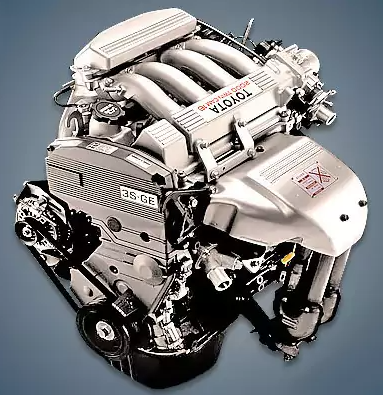
In 1984, one of the most well-known Toyota engines was introduced. With a 4-cylinder cast-iron block and a sports 16-valve cylinder head created by Yamaha engineers, it was a traditional multi-injection engine. Here, the timing belt rotates both camshafts rather than just the intake, in contrast to other engines in the series. The unit was equipped with numerous cutting-edge systems, which we will go into greater detail about below.
This power unit’s numerous iterations are typically categorized into five generations:
- The 3S-GELU, the first generation of these engines, was manufactured between 1984 and 1989. The Japanese version produced 160 horsepower because of the T-VIS system and lack of an EGR valve, while the American version with pistons for a compression ratio of 9.2 only produced 135 horsepower.
- Produced between 1989 and 1993, the second generation was identified by its distinctive cover. The engine’s power was increased to 155 and 165 horsepower, respectively, by increasing the compression ratio to 10. Additionally, the more effective ACIS has replaced the T-VIS variable intake system.
- From 1993 until 1999, the company manufactured the third generation of power units, or 3S-GE gen3. Export engines gained 170 horsepower, while Japanese engines gained 180 horsepower, and the compression ratio increased once more to 10.3.
- There were two variations of the fourth generation of 3S-GE Beams, each with a different cap color. The Gray Top modification produced power between 180 and 190 horsepower and was identified by its black and gray top. From 190 to 200 horsepower, the Red Top version with a red valve cover had a little more power. The compression ratio increased to 11.1, a VVT-i type phase control system appeared on the intake camshaft for the first time in the series, and these power units were essentially identical technically.
- From 1997 to 2005, only the Japanese Altezza model was equipped with the fifth generation, also known as Black Top. The exclusive Dual VVT-i dual phase control system made its debut on this unit. With a compression ratio of 11.1, this engine’s automatic transmission version produced 200 horsepower. With a compression ratio of 11.5, the manual transmission modification produced roughly 210 horsepower.
The engines in the S family are 4S-Fi, 4S-FE, 3S-FC, 3S-FE, 3S-FSE, 3S-GE, 3S-GTE, and 5S-FE.
The engine was mounted on:
- Toyota Altezza 1 (XE10) in 1998 – 2005;
- Toyota Camry 1 (V10) in 1984 – 1986; Camry 2 (V20) in 1986 – 1992; Camry V30 in 1990 – 1994;
- Toyota Caldina 1 (T190) in 1992 – 1997; Caldina 2 (T210) in 1997 – 2002;
- Toyota Celica 4 (T160) in 1985 – 1989; Celica 5 (T180) in 1989 – 1993; Celica 6 (T200) in 1993 – 1999;
- Toyota Corona 8 (T150) in 1985 – 1987; Corona 9 (T170) in 1987 – 1992; Corona 10 (T190) in 1992 – 1996; Corona 11 (T210) in 1996 – 2001;
- Toyota Curren 1 (T200) in 1994 – 1998;
- Toyota MR2 2 (W20) in 1989 – 1999;
- Toyota RAV4 1 (XA10) in 1994 – 2003.
Specifications
| Production years | 1984-2005 |
| Displacement, cc | 1998 |
| Fuel system | injector |
| Power output, hp | 135 – 180 (1, 2, 3 gen.) 180 – 210 (4, 5 gen.) |
| Torque output, Nm | 170 – 190 (1, 2, 3 gen.) 190 – 215 (4, 5 gen.) |
| Cylinder block | cast iron R4 |
| Number of valves | 16 |
| Cylinder bore, mm | 86 |
| Piston stroke, mm | 86 |
| Compression ratio | 9.2 – 10.3 (1, 2, 3 gen.) 11.1 – 11.5 (4, 5 gen.) |
| Hydraulic lifters | no |
| Timing drive | belt |
| Turbocharging | no |
| Recommended engine oil | 5W-30, 5W-40 |
| Engine oil capacity, liter | 3.9 4.2 |
| Fuel type | petrol |
| Euro standards | EURO 2 (1, 2, 3 gen.) EURO 3 (4, 5 gen.) |
| Fuel consumption, L/100 km (for Toyota Altezza 2000) — city — highway — combined |
11.9 7.2 8.6 |
| Engine lifespan, km | ~500 000 |
| Weight, kg | 155 |
Disadvantages of the Toyota 3S-GE engine
This line’s power units are all very dependable, but there is still one drawback: after 200,000 kilometers of operation, oil consumption frequently reaches a liter per 1000 kilometers.
Although this timing belt has a remarkable margin of safety, you shouldn’t inspect it. This motor’s beam versions bend the valves with a break and lack piston recesses.
EGR valve-equipped modifications frequently experience floating engine speeds because the valve gets clogged with soot very quickly and then starts to wedge. Keep your throttle body and fuel injectors clean for the same reason.
It is typical for this motor to be quite noisy and prone to vibrations. Check the engine mounts’ condition on a regular basis, though, as they are not very dependable. There are no hydraulic lifters, and valves may occasionally need to be adjusted due to knocking.
Like any aging power unit, there are enough minor issues: ignition system parts and certain engine sensors malfunction more frequently than others.