
From 1989 until 2004, the 4.0-liter V8 Toyota 1UZ-FE engine was built at the Tahara plant and fitted to the Japanese company’s most potent rear-wheel drive models. The motor comes in two generations: the 1997 model with the VVT-i system and the 1989 model without a phase regulator.
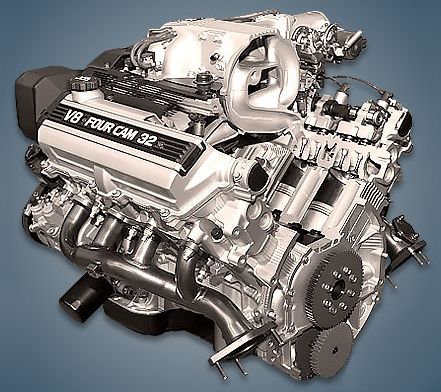
The UZ series’ first engine, a 4.0-liter model, made its debut in 1989. This engine was an eight-cylinder V-shaped engine with an aluminum cylinder block, two aluminum heads with four valves each and no hydraulic lifters, a timing belt drive, and an ignition system with two coils and two distributors.
This unit was upgraded for the first time in 1994. Lightweight connecting rods were added, the injection system was changed from MFI to SFI, and the compression ratio was increased from 10 to 10.4, giving the engine an additional 5 horsepower. The VVT-i phase control system was added to the engine as early as 1997. Additionally, individual ignition coils emerged, and the compression ratio rose to 10.5 once more.
The 2UZ-FE and 3UZ-FE engines are part of the UZ family.
The engine was mounted on:
- Toyota Aristo 1 (S140) in 1991 – 1997; Aristo 2 (S160) in 1997 – 2000;
- Toyota Celsior 1 (XF10) in 1989 – 1994; Celsior 2 (XF20) in 1994 – 2000;
- Toyota Crown 8 (S130) in 1989 – 1991;
- Toyota Crown Majesta 1 (S140) in 1991 – 1995; Crown Majesta 2 (S150) in 1995 – 1999; Crown Majesta 3 (S170) in 1999 – 2002;
- Toyota HiAce 4 (H100) in 1989 – 2004;
- Toyota Soarer 3 (Z30) in 1991 – 1997;
- Lexus GS S140 in 1991 – 1997; GS S160 in 1997 – 2000;
- Lexus LS XF10 in 1989 – 1994; LS XF20 in 1994 – 2000;
- Lexus SC Z30 in 1991 – 2000.
Specifications
| Production years | 1989-2004 |
| Displacement, cc | 3968 |
| Fuel system | injector |
| Power output, hp | 250 – 260 (non VVT-i) 290 – 300 (with VVT-i) |
| Torque output, Nm | 355 – 365 (non VVT-i) 400 – 420 (with VVT-i) |
| Cylinder block | aluminum V8 |
| Block head | aluminum 32v |
| Cylinder bore, mm | 87.5 |
| Piston stroke, mm | 82.5 |
| Compression ratio | 10 – 10.4 (non VVT-i) 10.5 (with VVT-i) |
| Hydraulic lifters | no |
| Timing drive | belt |
| Phase regulator | no (non VVT-i) VVT-i (with VVT-i) |
| Turbocharging | no |
| Recommended engine oil | 5W-30, 5W-40 |
| Engine oil capacity, liter | 5.6 |
| Fuel type | petrol |
| Euro standards | EURO 2 (non VVT-i) EURO 3 (with VVT-i) |
| Fuel consumption, L/100 km (for Toyota Celsior 1999) — city — highway — combined |
14.9 9.2 11.8 |
| Engine lifespan, km | ~500 000 |
| Weight, kg | 220 |
Disadvantages of the 1UZ-FE engine
For the duration of the warranty, the 1UZ power unit is sufficiently resistant to even very minor defects. It essentially lacks serious structural and design flaws for both individual units and the entire system. As a result, they all have a distinctive age tint that appears when they reach a high mileage if malfunctions become apparent. Additionally, extreme operation, the use of inferior fuels and lubricants, and a lack of technical inspection can all lead to malfunctions.
Candles are frequently rendered useless by the motor. Poor gasoline is the primary cause in this instance. It is very challenging to replace them yourself. The motor’s FE modification is so dependable that the majority of customers have long referred to it as a “millionaire.” In any event, the motor can safely travel 500,000 kilometers or more with the right upkeep and premium fuels and lubricants.